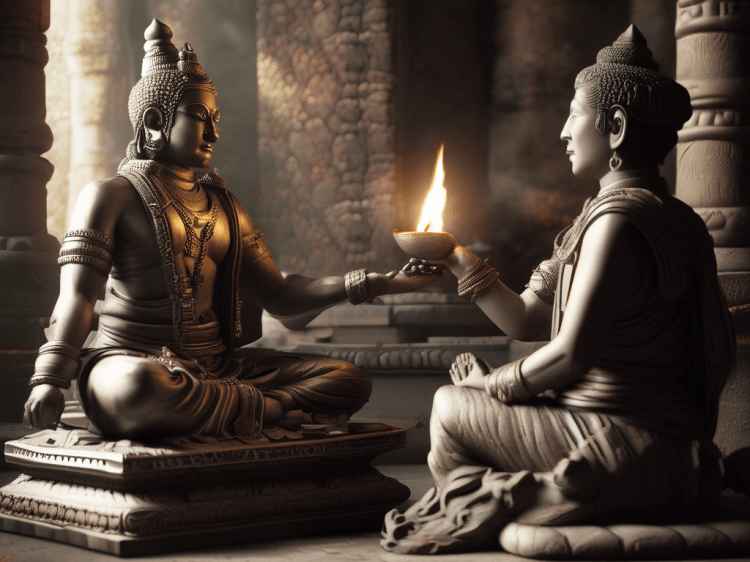
Episode # 1354 – “Whom should we believe in & whom should we not?” – Bhishmachaarya explains!!!

In the previous episode, we had witnessed the continuation of an important conversation between a king and Sage Thanu with regards to “belief” and how fragile it can be in our daily lives. While Sage Thanu substantiates his point through several instances and examples, the king slowly restarts the talk that he wants his dead son to come back alive, and he has immense belief that this would happen. Looking at the king for a moment, Sage Thanu with all his immense power of penance, brings the king’s son back to life! He walks towards his father and with this, the king is extremely happy! Now, upon seeing his son back, the king asks an important question to Sage Thanu that till now he was telling that belief is fragile, but now, only because of his strong belief, he has got his son back! How can one say that belief is fragile in nature? Without belief, could this have happened? If a dead son can come alive with a strong belief, anything else can be possible in this world with proper belief, isn’t it? 

As the king asks thus, it might seem to us that Sage Thanu’s words can be a little misleading with regards to belief being fragile. As Sage Thanu listens to this narrative of the king, he immediately resorts to clarifying his point. He says thus, “Oh King! I think you’ve misunderstood what I’ve said till now – The examples and instances that I’ve narrated till now involve people who have denied help at a time of need, people who is mentally unstable, etc. from whom one can be very sure that no kind of help is going to come. But when you asked me for help, I’ve never said a “No” to you! Thus, in order to keep up the confidence and also to prove that there can be a belief which can be fatter / stronger than my physical appearance, I decided to bring your son back to life! Till now I’ve told you about beliefs which can be more fragile than me, but there are a few items with regards to belief, which can be stronger than me as well. One such kind of belief is the one which you had on me, which enabled your son to come alive again! Now let me narrate to you which are the types of beliefs which are stronger than my physical appearance. Thus, you should understand that whoever talks the “Satya-Vaakyam” (Truth) can be the ones whom you can believe in! For instance, I’m a sage, and because of my power of penance, I’m someone who only talks the truth. You had an immense belief that if you come to me, your son can come alive. Once you believe in a person who talks the “Satya-Vaakyam”, your belief should not get futile. That is the reason behind your son being alive. Hence, belief can always be on people who talk the truth! Belief can always be towards Bhagawan! Belief can always be towards great sages who have immense power of penance in them!” 

Now this is a very important lesson for all of us as well. It is not that belief is fragile everytime. If we believe in the wrong person, of course, it can be very fragile. Bhishmachaarya says this to Yudishtra by saying that his belief about Duryodhana mending his ways was extremely fragile in nature, because Duryodhana was a man of “Adharma”. Similarly, Karna trusted Duryodhana to such an extent that he would mend his ways. But till the last moment he did not. However, Karna did not let his belief go down, and because of it, he did not want to desert Duryodhana and switch to Yudishtra’s side, even though he knew his past from Bhagawan Krishna. Such belief can always be futile. So for today, let us understand this point very clearly and we shall move on from here in the next episode! Stay tuned! 🙂 

Episode # 1353 – “Do we have belief in Bhagawan or on other worldly affairs?” – An important discussion!!!

In the previous episode, we were amidst a very interesting conversation between Sage Thanu and a king with regards to “belief” and how it is very fragile in nature. Bhishmachaarya is narrating this particular conversation to Yudishtra, to highlight the point that belief doesn’t hold any waters beyond a point in life. Per the conversation, we’ve witnessed that the king has lost his son and is having a “belief” that he would come back to him some day. This king is intercepted by Sage Thanu, who is trying to make him understand that such beliefs in this world do not have any value. However, the king is not getting convinced and this forces Sage Thanu to explain how fragile belief is in this world. He narrates three to four instances wherein belief is fragile – For instance, having the belief that an opportunistic person whom we’ve helped a lot in the past will not ditch us when we are in need of something, is one of the most fragile beliefs that we might have. If we have a belief that a mentally unstable person will do something good for us, this is also something which is extremely fragile in nature. This is because, as all of us know, mentally unstable people are extremely unpredictable in nature. How are we going to expect something sensible and good from them? Isn’t it a folly? Similarly, people who are opportunistic – How can we expect something good from them? Believing in such people is the stupidest thing that we can do in life! 

Saying thus, Sage Thanu continues further to give more such instances wherein belief can be more fragile than his own physical appearance. We’ve seen earlier that Sage Thanu is merely a bag of bones with a tall figure. He doesn’t have any fat in any part of his body, which makes him look very scaly like a skeleton moving around. If there can be something more fragile than Sage Thanu’s physical body, there can be nothing else in this world other than belief. Sage Thanu continues further thus, “Oh king! Imagine a person having a single son, who is working in some place far away from his father. One day there’s news that the entire place where his son is working is affected by an earthquake and there are no survivors there. If the father believes that his son might still be alive amidst the debris of the buildings, isn’t this belief more fragile than my physical appearance? Oh king! Let me tell you another example of this sorts – Imagine a king of a small empire looking at someone like King Dasharata or any other king of a large territory and saying that he wants to have his coffers filled up like how King Dasharata has! Can a small king ever achieve the amount of wealth that King Dasharata’s coffers have? If this small king has such a belief, of course it is extremely fragile in nature, isn’t it?” 

As Sage Thanu describes all such scenarios, we also understand that belief is something which is extremely fragile in nature. Of course, I’m not saying that we should never have belief in anything or anyone. It is important. But whom are we having belief upon? If it is upon Bhagawan that He would protect us at all times, then this belief is extremely strong and can never be fragile. Whereas, if this belief is towards worldly affairs, then obviously it is going to be fragile in nature! This is the lesson that all of us have to learn through this story. The story of course doesn’t end here. It continues further. Now that the sage has outlined that belief is extremely fragile in nature, the king slowly asks the sage thus, “Oh Sage Thanu! My entire belief revolves around my son’s life. I’m still having the belief that he will come to me someday. Now tell me if this belief is fragile or not!” Upon hearing this from the king, Sage Thanu understands the level to which the king is affected and obsessed with his son. He decides to teach the king a lesson, and in that process, with his extreme power of penance, Sage Thanu brings back the king’s dead son to life! As this happens, the king’s son comes back alive in front of the king! With this, the king is extremely happy! 

Now the king asks the sage once again thus, “Oh Sage Thanu! Till now you’ve been telling me that belief is extremely fragile, weren’t you? I have proved to you today that having a belief is not as fragile as you’ve mentioned! What is your take on this?” This is a very important question that the king has asked here, and I’m sure we might also have the same question in our minds too – Till now we were witnessing that belief is extremely fragile and there’s no point in believing that a dead person will come alive in this world. Now the same Sage Thanu has brought back the king’s dead son to life! Isn’t this contradicting? So, can we have a belief that is not as fragile as how it was projected earlier? We shall wait till the next episode to witness Sage Thanu’s interesting answer to this riddle! Stay tuned for an absorbing accord! 🙂 

Episode # 1352 – “Belief is extremely fragile – How?” – Bhishmacharya explains Sage Thanu’s accord!!!

In the previous episode, we had witnessed Bhishmachaarya talking to Yudishtra about “Belief” and how fragile it is. He narrates a story in the regard to justify his stance. Bhishmachaarya talks about a king whose son had been killed, but the king still had the belief that his son would be back with him sooner or later. With this strong belief, when he goes searching for his son amidst the thick forest, he comes in contact with Sage Thanu and the others, who ask him some “uncomfortable” questions. Sage Thanu tries to explain to the king that once a person is dead, it is impossible that he / she comes back to this earth in the same physical form. But the king wasn’t in a mood to listen to this narrative from Sage Thanu. He builds up his own narrative by posing a counter question to Sage Thanu. The king says to the sage if that is the case, the entire concept of “belief” is wrong! The king asserts that the entire human life in this world revolves around belief, and what is wrong in believing that his son would come back to him?

This is exactly where all of us also get stuck with many things in life! For instance, we might develop a lot of love / affection over someone or something, and when that person / object goes completely out of our sight due to whatsoever reasons, we will never be able to digest the fact that we’ve to live without that person / object. Rather than coming to terms with reality, we still keep believing that someday in our lives, we will be able to meet that person whom we are missing, or we will be able to attain that thing which we miss so much! We spend years thinking of whatever we’ve missed, with the belief that we would be able to get them back! Of course, in some cases it might be possible, but in many cases it might not! Even in our daily lives, we plan a lot of things for the entire month ahead, or even for a year’s time. For instance, we plan long-term investments, save money for something that might happen after four to five years from now, etc. isn’t it? Upon what? It is only upon the belief that we would be alive until that time to enjoy the fruits of our investments, isn’t it? However, the fact of life is that, we never know if we’ll be alive the very next moment! All of us might have seen what happened recently in the Indian state of Kashmir – There were many tourists who had gone to a place called “Pahalgam” in Kashmir, in a bid to celebrate their holidays. However, from some corner of that place, there were a few Islamic terrorists who came and shot several tourists, out of which, 26 of them died on the spot! While going for the tour, did anybody anticipate such a disaster? So, the lesson here is that life in this world is extremely uncertain. Anything might happen at any time, and hence, we always say that we’ve to live our present moment to the fullest. Of course, all of us know all these “Vedantic” concepts, but we keep planning deep into our future, don’t we? Why do we do so? It is because of this same belief! 🙂 

This is exactly what the king is asking Sage Thanu here – While the entire life is based upon belief, how can one claim that belief is very fragile in nature? For this, Sage Thanu replies thus, “Oh king! Yes! You heard me right! Belief is something which is extremely fragile in nature and can be shattered at any point in time. We’ve to be prepared for it!” As Sage Thanu sticks to his stance thus, the king is still not convinced. He asks back thus, “Oh Sage! Is belief more fragile than you? You seem to be extremely fragile with such a thin structure and body composition! Can belief be more fragile than your body?” For this, Sage Thanu laughs out loud and replies back thus, “Oh my dear king! Yes. I still stick to my stance. Belief is more fragile than me, and I can even prove it to you!” 

Saying thus, Sage Thanu lists a few instances wherein human belief can be extremely fragile in nature. He continues thus, “Oh king! Now let me give you a few instances wherein belief is extremely fragile – If person “A” is promising that he would do something good to Person “B” and the latter is in this belief constantly – Some day, person “A” ditches person “B” for whatsoever reason and person “B” also knows this. Even then, person “B” still keeps believing that some day or the other, person “A” will do something good for him! This is how belief is fragile in nature – Even when a person knows that the other is ditching him royally, he still keeps believing that the other person will do something good for him some day! Can there be anything more fragile than this? Secondly, if person “A” forgets / not recognizes the help that he had obtained from person “B”, and deserts him during a critical way, and person “B” keeps thinking that person “A” would return his favour at some point in time, this is also a case wherein belief is extremely fragile in nature! Thirdly, if person “A” believes in person “B”, who is mentally unstable – This also shows how fragile belief can be! Fourth, if person “A” believes in person “B” who is extremely lazy in nature – This also shows how fragile belief can be! Oh king! If you believe in these kinds of people in your life, this belief that you have would be more fragile than me!”

Saying thus, Sage Thanu illustrates how fragile belief can be in this world! So for today, let us understand up to this point, and in the next episode, we shall continue this further! Stay tuned! 🙂 

Episode # 1351 – “Is belief really fragile?” – Bhishmachaarya explains with a story!!!

In the previous episode, we had witnessed Bhishmachaarya talking about “belief” to Yudishtra, and how this belief is such a fragile element in life. In other words, beliefs might be based on several assumptions, and they might be shattered at any point in time. To highlight this point, Bhishmachaarya is narrating a beautiful story of a king who chases a deer as part of his hunting spree. He gives a long chase, however, the deer is smart enough to escape everytime the king tries to hit it with his arrows. Even after giving such a long chase, the king believes that he will be able to catch the deer. As he gets tired, hungry and thirsty, the king approaches a group of sages, who help him with sumptuous food and water. Upon being questioned by the sages of coming alone into this dense forest, the king explains that he was on a hunting spree and was trying to catch hold of a deer, which is escaping from his sight every time. As the sages listen to this accord, they ask whether the king intends to continue the chase or not, for which, the king replies in the affirmative! 

Upon listening to the king’s reply, the sages now talk thus, “Oh king! You’ve come all alone here! You’ve been chasing a deer, which is afterall an animal. Now you are standing and talking with us for the past 15 minutes or so. Before that, you’ve been sitting here and having food and water for the past 30 minutes or so. Adding both together, you’ve spent almost 45 minutes to an hour in this place itself. Now, within this one hour, the deer might have jumped up and ran several miles from this place! How will you go and find it now? Where will you go and search for that deer?” For this, the king replies the same way as Yudishtra did just now – “I just have the belief that I’ll capture that deer! Nothing else!” This is exactly what Bhishmachaarya is making Yudishtra understand – From this, we can see how fragile “belief” could be! We also go behind several worldly things in our daily lives, don’t we? Sometimes we might be able to achieve a few things, many times, we might fail! However, we always keep saying that when we encounter failure, we should “never give up”! Of course, this is correct. We should never give up our pursuit just because we’ve failed once. But, the context where this is applied is very important. Are we applying this for merely worldly attainments or are we trying to strive for higher-level needs like attaining “Moksha”, trying hard to walk the spiritual path, etc.? 

As Bhishmachaarya explains this to Yudishtra, the story doesn’t end here. Now the king asks the sages thus, “Oh Sages! You’re ridiculing my belief of capturing that deer. First of all, what is belief? How is it important / not important for human beings?” As the king asks, the sages show Sage Thanu who is sitting amongst all of them and explain thus, “Oh king! Belief is like Sage Thanu who is sitting here! Look at him – He is so tall (More than 6.5 feet), but very fragile with no fat anywhere. He is just a bag of bones, isn’t he? Belief is also like this only! It is very fragile in nature! Before you came here, two others came to meet Sage Thanu a while ago. One of them is by name “Veera-Dhyumna” and he is the son of a king, who is the other person. This “Veera-Dhyumna” encounters an unfortunate death, upon which the father was coming along this way, searching for his son. This is where he met Sage Thanu. As Sage Thanu questions the king on why he was roaming here and there amidst this dense forest, the king replies thus, “Oh great Sage! I’m searching for my son! He is dead! I’m believing that my son will come back some day, and perhaps he might be here amidst this dense forest somewhere! I’m trying to find where he will be and once I find him, I’ll take him along with me to my kingdom!” 

This answer might sound very weird from the king, doesn’t it? We’ve to understand here that the king is talking this way because of his excessive attachment towards his son. The king could not digest the fact that his son is no more, and hence, he is resorting to such behaviours. Consoling the king, Sage Thanu replies back politely thus, “Oh great king! Those people whose “Karma” is over in this world, will automatically encounter death! It seems that your son’s “Karma” is over in this world and hence he has died. Please understand that those people who have died, will never come back again!” As the sage replies thus, the king counters him immediately – “Oh Great Sage! Please do not say this! My son will definitely come back! I have this belief in me! He will be here somewhere and I shall search for him!” As the king is in tears, the sage consoles him once again and replies thus, “Oh my dear king! You are wrong! Of course, I appreciate your belief, however, it doesn’t work this way! Your belief is very fragile and is not practical in nature!” As Sage Thanu tries to explain him calmly thus, the king is not very satisfied with this explanation. The king asks thus, “Oh Sage Thanu! You are a great Sage! You’ve performed immense penance all through your life and you’ve explored all secrets of life, haven’t you? So tell me this – Our entire life revolves around belief, isn’t it? For instance, we ride a chariot. Whenever we want to stop the chariot and try to stop it, we believe that the chariot can be stopped if the brakes are applied, isn’t it? Similarly, the entire fabric of life revolves around belief, isn’t it? How can you say that belief is very fragile in nature?” 

Now this is a very important question that the king has asked Sage Thanu. Bhishmachaarya is narrating this story to Yudishtra to highlight the importance of belief in life. So for today, let us understand up to this point and in the next episode, we shall continue with Sage Thanu’s answer to the king! Stay tuned! 🙂 

Episode # 1350 – “What is ‘belief’?” Bhishmachaarya narrates a beautiful story to highlight!!!

In the previous episode, we were witnessing a detailed accord on what is “Belief”, as narrated by Bhishmachaarya to Yudishtra. Upon Yudishtra’s lamenting that Duryodhana never mended his ways till his last moment, Bhishmachaarya wonders what makes Yudishtra think that Duryodhana would do so! Upon this, Yudishtra opens up to Bhishmachaarya that he “believed” that Duryodhana would realize his folly atleast at the Kurukshetra battlefield upon seeing a huge army in front of him, along with Bhagawan Krishna sitting opposite to him. Yudishtra also openly says that he did not go to the Kurukshetra battlefield to fight the war. He was expecting Duryodhana to come to him, seeking an unconditional apology, with which, an arrangement can be made in such a way that he rules one half of the Hastinapura kingdom and Yudishtra rules the other. With this, Yudishtra believed that the entire conflict between the two groups of brothers (Paandavas and Kauravas) would have come to an end and people would have also lived happily and peacefully under both the kingdoms. However, nothing of that sort happened, and Yudishtra was forced to fight the disastrous war. 

As Bhishmachaarya listens to this, he narrates a story wherein it is a conversation between Sage Thanu (A personification of “Belief”) and a king. While the king loses his son way too early in a battle, he is still under the belief out of his “Putra-Vatsalyam” that his dead son would come back to him some day! The context is beautifully set by Bhishmachaarya from this story. Now let us get into it. Bhishmachaarya narrates thus, “Oh Yudishtra! Once upon a time, this king, out of frustration of losing his son, goes on a hunting spree into a dense forest. He looks here and there and spots a young small deer jumping its way through. Upon seeing this deer, the king thinks that he has got a good catch today, and hence, tries to corner the deer with his arrows. The moment the king fires his arrows, the deer learns that it is being targeted by a human being, and hence starts to run. The king follows it! He fires two more arrows on the deer, in a bid to make it come to a halt. However, the deer is smart enough to evade the arrows from the king and it keeps running further! The king gives a big chase and the deer keeps up with the king’s pace of running. Everytime the king tries to target an arrow towards it, the deer escapes somehow and keeps running here and there. At times, the deer tries to trick the king by making him believe that he could catch it. However, when the king goes aggressively for the pursuit, the deer escapes away!

This keeps happening till a point that the king is extremely tired and frustrated! He is panting for breath, with a lot of hunger and thirst. As the king reluctantly gives up his pursuit towards the deer, he slowly treads towards a group of Sages sitting under a tree canopy and discussing something amongst each other. As the king approaches the sages, he requests thus, “Oh great Sages! I know and understand that you’re busy in some deep discussions. However, I’m forced to disturb you in the middle, as I’m very hungry and thirsty. Can I have some food to eat and some water to drink?” As the king requests thus, the Sages are more than happy to help him. They offer him sumptuous food and high-quality water to drink. With this, the king regains all his lost energy and gets ready to leave. 

As the king is about to depart, the sages ask the king thus, “Oh King! If we may know, where are you going? Why were you panting with a heavy breath? What are you looking for in this forest? Why have you come all alone? Where are your fellow warriors?” As the Sages ask multiple questions thus, the king replies – “Oh great Sages! I’ve just come to the forest on a hunting spree. I had spotted a small deer which was jumping its way through. I wanted to capture it somehow, and when I started trying, the deer started running away! I had to give it a chase, but I couldn’t make it stop! Thus, I was breathless and hungry, which made me approach you for food and water!” Upon listening to this accord from the king, the Sages ask back thus, “Oh king! This is fine! But what are you going to do now?” The king replies – “Oh Sages! Now that I’m full with food and my thirst has also come down, I shall once again continue my pursuit towards that deer and eventually capture it!” 

As the king says thus, the Sages are surprised! They ask back thus, “Oh king! By the time you’ve consumed your food and water, the deer would have gone several miles away. You will also not know in which direction the deer would have trudged along! How are you so confident that you will trace that deer and capture it?” As the Sages ask thus, the king replies in a lower tone – “Oh Sages! I have the belief within myself that I will capture the deer by the end of today!” So here, we see the word “belief” which is being employed by the king! So what is this belief all about? Isn’t it very fragile in nature? On what basis is the king exuding confidence that he will be able to capture the deer?” Narrating this part of the story, Bhishmachaarya draws parallels between this king and Yudishtra here. While the king believed in capturing the deer, Yudishtra also believed that Duryodhana would mend his ways! So what happened to this belief of the king? Did the belief succeed? Let us wait till the next episode to continue this story forward! Stay tuned! 🙂 

Episode # 1349 – “‘Belief’ is extremely fragile in nature!” – Bhishmachaarya explains to Yudishtra!!!

In the previous episode, we had witnessed the continuation of the lengthy accord on “Raaja-Dharma” by Bhishmachaarya to Yudishtra. Now, a heart-broken Yudishtra, after listening to several important aspects of leadership and “Raaja Dharma” laments to Bhishmachaarya that he expected Duryodhana to mend his ways till the last day at the Kurukshetra war. However, nothing of that sort happened and finally he, along with his ninety-nine Kauravas had to face destruction. Had Duryodhana even once felt remorse in the Kurukshetra battlefield, with Bhagawan Krishna in front of him, things would have been different. Yudishtra was ready to put down my weapons even during the last moment and a deal could have been arranged for. Hence, Yudishtra asks Bhishmachaarya as to what prevented Duryodhana from coming forward and seeking forgiveness for all that he had done. 

As Yudishtra says this with a lot of emotions, a moved Bhishmachaarya replies back thus, “Oh Yudishtra! I understand your point. But you’ve had good expectations from a bad person! Please understand that Duryodhana wasn’t the person whom you think he was! He had been conspiring against you right from day one. He had tried to kill all of you on several occasions in the past as well. Have you forgotten all of that? If such is the case, how do you expect Duryodhana to walk the path of “Dharma” by having remorse for whatever he had done to you?”As Bhishmachaarya asks thus, a sad Yudishtra replies back – “Oh Bhishmachaarya! I had that belief that he would change! Nothing else! I was just thinking that upon seeing a huge battleground, lakhs of people, horses, elephants, etc., and on top of everything, Bhagawan Krishna standing against him – Duryodhana’s mind would give up and he would come to me. It was just a belief that Duryodhana’s conscience would be shaken up atleast a bit and he would come to me for brokering peace! Oh Bhishmachaarya! If you ask me, honestly, I never came to Kurukshetra to fight the war! I was hoping that things would change for good! But that belief within me was broken to pieces!” 

As Yudishtra laments thus, Bhishmachaarya lets out a laugh and says thus, “Oh Yudishtra! Let me tell you something – “Belief” is a very fragile thing with a soft “Shareeram” and is not easy to manage at all times!” Bhishmachaarya says this and pauses for a second, which leaves Yudishtra confused! He asks Bhishmachaarya thus, “Oh Bhishmachaarya! You’re saying that belief is fragile! You’re saying that it has a soft “Shareeram”! What do these sentences mean? Are you trying to tell me that we should never believe in anybody in this world? Please give me more clarity!” As Yudishtra asks thus, Bhishmachaarya explains in detail – “Oh my dear Yudishtra! You’re matured enough to understand this! Anyway, let me tell you a small story to highlight this point further – “Belief” is personified in the form of a sage – This sage is none other than Sage Thanu. (Thanu means “Shareeram” in Sanskrit). This Sage Thanu is someone who has a slim body, but very tall! He never had any fat in any of the places in his body! In fact, he was just a bag of bones, and nothing else! There was an interesting conversation between this Sage Thanu and a king, and let us delve into it. This king’s son had met an unfortunate death at a very tender age. Upon knowing that his son is no more, the king could not believe it. His heart was broken to pieces and he could not accept this reality that his son is no more! However, the king had a belief that his son was still alive and would come back to him some day! The story here is about this king and his belief, and how Sage Thanu is going to answer him!” 

As we look into this story, we should also understand how fragile “belief” is. All of us might have a lot of beliefs and we might be very confident about them. However, we might not be able to understand at certain points in time, which of those beliefs are believable and which are not, isn’t it? We might believe in something or someone so deeply that one fine day we would come to know that it is completely fake! With this, our hearts will break, won’t they? This story is about this concept and in the next episode, we shall witness it and learn a few important lessons from it, as narrated by Bhishmachaarya! Stay tuned! 🙂 

Episode # 1348 – “I thought Duryodhana would mend his ways!” – Yudishtra laments to Bhishmachaarya!!!

In the previous episode, we had witnessed Bhishmachaarya’s continuation of his accord on “Raaja Dharma” to Yudishtra. Here, we’re witnessing a very important point made by Bhishmachaarya with regards to effective leadership – If we’ve to trust someone, it should not happen so easily. At the same time, if we’re trying to help someone, we should know if the person whom we are helping, is really eligible to receive our help or not. Moreover, even if the person is eligible, we should be very careful not to cross the boundary. We should not go beyond a point and help anyone. Else, this can backfire at us very badly. Bhishmachaarya narrated a beautiful story to highlight this point. The story was between a sage and a dog, wherein the dog was becoming more and more greedy with more and more help coming from the sage. Finally when the dog got into the form of a “Sharabam” bird, it thinks of finishing the sage who helped it all these days! Of course, the sage was extremely powerful with his penance, and taught the dog a befitting lesson by bringing it back to its original small and helpless form! We will not be able to give such befitting replies to people during such critical junctures, can we? Hence, we’ve to be very careful with the boundary to which we can offer help to anyone. Of course, I’m not saying that we should refrain from helping people. Definitely not! However, the point here is that there’s a fine balance in how much help we can extend to people. 

Moving on further, after hearing this story, Yudishtra is perplexed! He is now slowly starting to open up to Bhishmachaarya more and more. Especially after Bhishmachaarya touched a very sensitive point earlier that Yudishtra is trying to run away from the kingdom, Yudishtra is asking Bhishmachaarya a very important question here. Yudishtra asks thus, “Oh great Bhishamchaarya! I have an important doubt here. You had earlier said that I should not run away from performing my duty, and in fact, poked me lightly by indirectly saying that I’m trying to do that. Let me tell you one thing – I’m steadfast in my duty, as you know me from childhood. When Duryodhana came to fight against me at Kurukshetra, I was ready to do my duty of fighting the war against him. However, I had a small ray of hope – Duryodhana as a person, might have something called “conscience” that could prick him at some point in time. Also, Bhagawan Krishna was on my side and was ready to lead the entire army towards him. Moreover, as the war began, Duryodhana started tasting defeat every passing day. Still nothing changed in him and he continued to be what he was. After analyzing all the mistakes that he had committed till then, and upon seeing Bhagawan Krishna on our side, I really thought that Duryodhana would call a truce, either during the commencement of the war, or during the course of the war. But nothing of that sort happened, and we were forced to kill Duryodhana. Why did this happen?” 

Yudishtra is asking a very important question here – It should be remembered that before the war commenced, Yudishtra and his brothers walked towards all the senior members of the Kaurava camp, including Bhishmachaarya himself, Guru Dhronachaarya, Sage Kripachaarya, etc. to seek their divine “Anugraha”. Even at that point in time, Yudishtra was slightly having a ray of hope that upon seeing Yudishtra and the Pandava brothers bowing down to all of them, Duryodhana’s heart would melt. But nothing of that sort happened! Duryodhana became more and more enraged and was ready for the war to begin. Why did this happen? How was Duryodhana stone-hearted to this extent? 

As Yudishtra asks thus, Bhishmachaarya laughs a bit. He knows what Yudishtra is meaning here. Bhishmachaarya replies thus, “Oh Yudishtra! How on earth are you asking such a question? You are an epitome of “Dharma” in all aspects, and Duryodhana was exactly pole-opposite to what you are! How did you even expect him to come to you and broker peace? Are you mad? Oh Yudishtra! You should remember this – Ever since your childhood days, Duryodhana has only tried to kill you and your brothers in every possible manner. He tried to push all of you into the River Ganga when you were all asleep. He tried to burn all of you in the “Laaksha-Griham” (Wax palace) while all of you were asleep. He insulted you and your wife Draupati publicly in front of everyone in the courtroom during the gambling game. Even during your forest life, he did not allow you to live peacefully! Given Duryodhana’s dismal track record, how did you even expect him to fall into the path of “Dharma” and come to you to broker peace?” 

As Bhishmachaarya jokingly asks thus, Yudishtra doesn’t know what to reply! He just says thus, “Oh Bhishmachaarya! I also know all these! However, I just had the hope and confidence in him that some day he would change! But that never happened till the eighteenth day of the war!” As Yudishtra says thus, Bhishmachaarya ridicules his level of hope and confidence by saying that one shouldn’t get carried away by too much of these two qualities! There should be a limit! Again, Bhishmachaarya is going to narrate a beautiful story to highlight this important point, but for today, let us understand this point very clearly. We shall wait till the next episode for the story! Stay tuned! 🙂 

Episode # 1347 – “Before extending help to someone, you should know who he is!” – Bhishmachaarya advises Yudishtra!!!

We’re at a juncture of a very important point in leadership being highlighted by Bhishmachaarya as part of his lengthy discussion on “Raaja-Dharma” to Yudishtra. Bhishmachaarya explains that a leader should not give over-importance to anybody around him. Due importance and respect should of course be given to all people, but giving respect and importance has a limit. A leader should not go overboard to give importance to someone and eventually this would backfire very badly at some point in time. To highlight this point, Bhishmachaarya is narrating a beautiful story, wherein a sage is trying to give excessive affection towards a dog. Whenever the dog is under attack by another animal like a tiger, lion, elephant, etc. the sage, with his immense power of penance, transforms the dog into the corresponding animal which is attacking it. For instance, if a tiger attacks the dog, the sage transformed the dog into a tiger, with which, the dog successfully chased away the tiger. This  happened several times with several animals. 

One day, a “Sharabam” bird comes to attack the dog. As usual, the dog comes and catches the feet of the sage for help, and the sage too transforms the dog into another “Sharabam” bird. Many of us might not know this – “Sharabam” is a bird which is one of the fiercest amongst the bird community, which has the power of both an animal and an eagle together. Once the sage transforms this dog into a “Sharabam” bird, as usual, he chases away the other “Sharabam” bird which comes to attack him. However, now there’s a slight change in the dog’s mindset. Till now it was very loyal to the sage who protected it time and again, but now as it became the “Sharabam” bird, the dog did not want to change back to its original form. It started thinking, “Oh wow! Being a “Sharabam” bird is such an awesome feeling! Every other animal and bird is fearing for me as I swag in front of them! This is wonderful! I would like to adorn this form forever and maybe I should convey my wish to the sage! However, the sage might not accept my wish and hence, maybe I should kill the sage when I’m in this “Sharabam” form itself!” 

Thinking thus, the dog, in the form of the “Sharabam” bird, prepares itself to attack the sage, who was the very person who had given this form to it. Without being loyal and thankful to the sage for protecting it time and again, the dog goes on the offensive. As the “Sharabam” bird looks for an opportunity to attack, the sage was in deep penance. Sensing that this is the best time for it to attack and kill the sage, the “Sharabam” bird tries to pounce on him. Realizing immediately that he is in a great danger, the sage opened his eyes, only to see the same “Sharabam” bird that he created, coming towards him in full force to kill him. Without wasting even a single second, the sage got to work and he immediately transformed the “Sharabam” bird into a dog (Original form) 🙂 Thus, the dog falls on the ground, rolls on the dust and mud, and once again comes and sits near the sage! It is back to its original sober form, and now it cannot do any more crooked things that it wanted to do earlier! 

This is a beautiful story narrated by Bhishmachaarya to Yudishtra, to highlight an important point that if we give too much importance to someone by going out of our way, this move can backfire at us very badly. The sage in this story went beyond his limits to protect the dog everytime with his power of penance. However, the help that he rendered to the dog misfired when the dog in the form of the “Sharabam” bird tried to backstab him! However, since the sage had enormous power of penance, he was immediately able to rejig himself from the trap by transforming the “Sharabam” bird once again into a dog within fraction of a second! Will we be able to do such things, if we are confronted with a similar situation in life? This is where we’ve to be careful. Of course, it is important that we help others as much as we can, but there is a limit to it. We should first know whom are we trying to help. Is the person really fit enough to receive our help? Or, is the person opportunistic in nature that he would some day come back and backstab us? This is where Bhishmachaarya cautions Yudishtra that before he entertains someone, he should first study that person fully inside out. Only then should he even allow that person to come closer. 

So for today, let us understand this important point highlighted by Bhishmachaarya to Yudishtra, and in the next episode, we shall continue this discussion forward! Stay tuned! 🙂 

Episode # 1346 – “Never show over-affection / respect towards anyone!” – Bhishmachaarya’s important leadership lesson!!!

In the previous episode, we had witnessed Bhishmachaarya’s continued accord on “Raaja-Dharma” to Yudishtra, wherein he talks about how Yudishtra should not panic when he sees an enemy in front of him. A leader should be calm and composed during critical times. When the enemy is in front of you, a leader should not immediately jump in to start attacking. At times, it is important that the leader adopts the “wait and watch” mode in analyzing the enemy’s strengths and weaknesses, and then commence the attack. Here, Bhishmachaarya uses a very important phrase – “Bowing down in front of the enemy”, which might sound a bit controversial here. We might immediately tend to ask why we should bow down towards an enemy. Doesn’t this show that we are cowards and unwilling to fight back? The answer is an actual “No”. Upon looking at this phrase for a deeper meaning, Bhishmachaarya actually means that by bowing down in front of an enemy, a smart leader tries to read and understand the actual intent of the enemy bit by bit. A leader should never give way to his emotions to take over at any stage. This is a way to have a control on the emotions, and with this, the leader is very calm and composed. If we’re emotional, we tend to make decisions which would result in blunders from our side! Hence, we’ve to be very careful while making crucial decisions, and one way to achieve this is to have control over our rush of emotions. 

Moving on further from this point, Bhishmachaarya tells Yudishtra thus, “Oh Yudishtra! As a king, you should know whom to keep where! If people are going against your will and wish, you should be ready to show them the mirror immediately and bring them back to your ways! This is very important! You should not keep giving importance to people more than what you should do!” This is a very important point that Bhishmachaarya is talking about in terms of leadership. As a leader, it is important to understand the level of our people around us and ensure that he / she is not given undue importance for anything at any point in time. Whatever importance / respect that needs to be given to a person, should be given without a doubt. Bhishmachaarya is never getting into that zone here. However, he says that the problem comes when we start giving undue importance and excessive respect towards people. If we start doing so, people will disregard us and start taking advantage of all the luxury that they receive from us. Eventually, they will not shy away from acting against us as well, during crucial times. 

To highlight this point, Bhishmachaarya is narrating yet another beautiful story here. Bhishmachaarya explains thus, “Oh Yudishtra! Once upon a time there was a great sage, sitting in a forest and performing deep penance. As the sage was in a deep meditative state, many animals started coming near him and sleeping beside him on several occasions. In this manner, one day a dog came and sat near the sage. All of a sudden, the sage started developing some sort of a compassionate feeling for the dog and started taking care of it very lovingly. That evening, all of a sudden a cheetah came close to the dog and threatened to attack and kill it. Panicking immensely, the dog ran to the sage, seeking protection from him. Moved by the dog’s precarious situation, the sage thought of how he could save the dog’s life. He immediately converted the dog into a cheetah with the immense power of his penance! Once the dog entered into a cheetah form, it became very ferocious and attacked the other cheetah back! A huge fight endured and this dog-converted-into-cheetah won the battle! In a bid to save its life, the other cheetah ran away into the forest and this dog once again obtains its original form! The sage’s compassion knew no bounds and thus, saved the life of the dog, for which, the dog was also thankful to the sage!”

Saying thus, Bhishmachaarya continues further, “Oh Yudishtra! Now the second enemy for the dog arrived – In the form of a tiger! Upon seeing a tiger attacking his favourite dog, the sage immediately converted the dog into a tiger, with his immense power of penance! The same story repeated, with the dog-converted-into-tiger launching a scathing counterattack! Eventually the tiger had to run away in a bid to save its life! Once again the dog regains its original form and thanks the sage! After a few days, once again the dog comes under attack – This time by a wild elephant! The same story repeats and the dog-converted-into-elephant counterattacks the other elephant and makes it run for its life! The same story repeated with when the lion attacked the dog as well! In this way, the dog was being protected by the sage with an “extra bit of care” every time he came under attack!” 

So for today, let us understand up to this point and we shall witness in the next episode how the dog is going to reciprocate the sage’s over-affection towards him! Stay tuned for an interesting accord! 🙂

Episode # 1345 – “Never let your emotions dominate while attacking an enemy!” – Bhishmachaarya advises Yudishtra!!!

In the previous episode, we had witnessed Bhishmachaarya continuing with his accord on “Raaja Dharma” with Yudishtra. Till now he had discussed several important aspects like trust, performing our duty without running away, and now he is talking about flexibility and humility. To drive this point home, Bhishmachaarya is narrating a beautiful story wherein “Samudra-Raaja” is asking Mother Ganga as to why she is not bringing along the bamboo tree’s branches to the ocean, but every other tree’s branches are being brought along! For this, Mother Ganga gives a very important reply that she is unable to bring the bamboo branches because the bamboo tree flexes itself and bows down in front of her every time in respect, whenever she is increasing her force. While the other trees stand rigidly to their pole position, Mother Ganga is easily able to uproot them and bring them along. However, since the bamboo tree flexes itself, she doesn’t have the heart to destroy it and bring its branches along. Hence, even after several attempts, Mother Ganga is unable to break the bamboo tree and bring it along with her. 

This accord from Bhishmachaarya gives us two important lessons – First one is “humility” and the second one is “flexibility” / “agility”. No matter how much we might have achieved in life, being grounded and humble is very important. Rather, if we’re going to keep boasting about our achievements and take a lot of pride from them, we have to face downfall somewhere or the other. This is just like how the other trees stand tall without being humble and grounded, and subsequently the river gushes down and washes them away! Here we can see clearly that the bamboo tree is not being washed away because it bows down to Mother Ganga. Similarly, no matter how much ever we might have achieved things in this world, we should always have the humility to bow down in front of the Supreme Bhagawan! If we do so, Bhagawan will ensure that we are protected at crucial times. 

Secondly, we learn the lesson of being agile or flexible. This is also very important in life. We might have seen some people in our personal and professional circles, being extremely planned and routine-based and they would try to stick to their plan every time, without adjusting for the convenience of others. In behavioral sciences, we call this the “Conscientiousness” personality trait. Of course it is good to be planned and routine based, but to what extent? Should we become so rigid that we would fail to accommodate genuine needs from genuine people? This is also not good. While planning is important, we shouldn’t get obsessed with it. Some people have this notion – Plan for the next twenty-five years and start saving enormous sums of money from now onwards! We should understand one thing clearly – Nobody knows whether we will be alive after twenty-five years from now! We’ve to learn to enjoy the present moment as well, along with the future planning that we’ve to do. Of course, I’m not against planning for the future. But the question comes – “For how long and how much?” We should be like the bamboo tree, which bends and flexes itself when the flow of the river is higher and then stands rigid when the flow becomes even or lower. We should be able to have the correct “checks and balances” in place, and this is important. 

Narrating this story thus, Bhishmachaarya continues his accord with Yudishtra – “Oh Yudishtra! Let me now come back to the point – Whenever you see an enemy, you should first bow down in front of him and understand who he is and his entire background, before taking your weapons and commencing a fight. This is very important. When I say “bow down in front of your enemy”, it doesn’t mean that I’m asking you to surrender in front of him. You should understand the fine balance here – When I say “bow down”, I mean to say that you’ve to be calm and composed in your counterattack. You should not give way to your emotions to take center-stage. If you do so, the battle is lost then and there! Only a person who steadies himself, calms himself down and understands the strengths / weaknesses of the enemy, will be able to win a battle! So just like the bamboo tree flexing itself to avoid getting washed away by the River Ganges, you should also flex yourself to avoid getting defeated by the enemy straightaway!” 

Now this is a very important point that Bhishmachaarya is discussing here, which is quite self-explanatory in nature. I don’t think I need to add any further on this point, as it is very evident with the beautiful explanation he gives here. So for today, let us understand up to this point, and we shall continue this discussion forward in the next episode as well! Stay tuned! 🙂