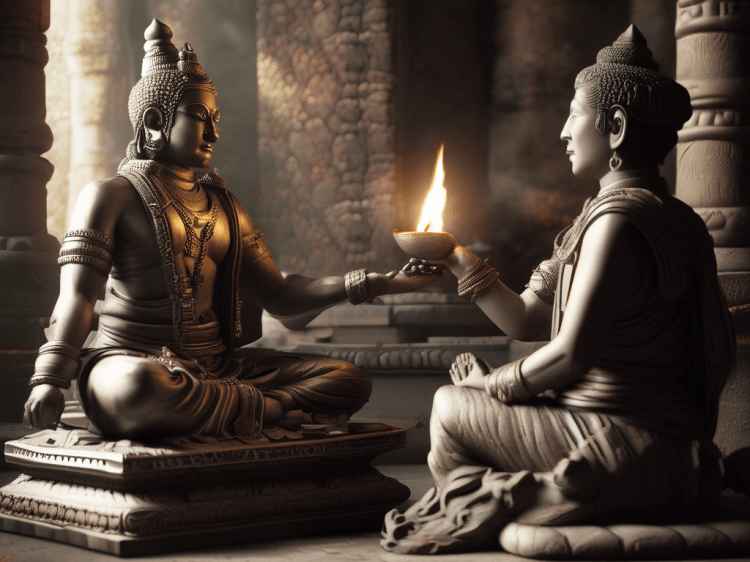
Episode # 1364 – Safeguarding & protecting “Dharma” – Bhishmachaarya narrates a beautiful anecdote!!!

In the previous episode, we had witnessed Bhishmachaarya continuing with his accord on the “Aapad Dharma” wherein he is explaining to Yudishtra the importance of three aspects while safeguarding “Dharma” – Power, wealth and motivation. These three factors are paramount when we try and protect our “Sanaatan Dharma” even today. For instance, we should first of all have the “will-power” to follow our “Dharma” correctly every passing day. Only if we have this fixed, will we be able to showcase our power extremely to the outside world. For “Dharma” to be protected, wealth is also required. This is why Bhishmachaarya has been explaining right from the beginning that the king should always have his coffers filled at all times. This will enable the leader to donate wealth to the needy at all times. The more we spend towards “Dharma-Kaaryam”, our “Sanaatana Dharma” will flourish. Thirdly, to showcase our prowess and channelize our wealth correctly, we should have the motivation within us, isn’t it? Without motivation and the internal drive, how will we even be able to perform our “Nitya-Anushtaanam” properly every day? If this itself is not happening, how are we going to defend ourselves in the external settings? Thus, the point here is that, motivation is the primary requirement, followed by the power and wealth, to protect and safeguard our “Sanaatana Dharma”. 

Taking these points forward, Bhishmachaarya is now going to explain a beautiful story of three fishes, to highlight all the above-mentioned points to Yudishtra. Once upon a time, there were three fishes in a big pond. These fishes had names. The first one was called “Dheerga-Kaalagnya”. The second one was called “Utpanna-Prathiba”. The third one was called “Dheerga-Soothri”. The first first – “Dheerga-Kaalagnya” was a great visionary fish – It can anticipate what will happen in the future with a lot of accuracy and act accordingly. The second one – “Utpanna-Prathiba” was extremely smart in nature – When there is an adversary, it knows exactly how to escape. Its brain is hyper-active in nature at all times! Whereas the third one – “Dheera-Soothri” – It is a highly inactive fellow! His brains never function at any point in time and is a very lazy fish! Even if there is a big problem approaching, this “Dheerga Soothri” fish will just keep sitting without any effort to move out! We have a colloquial analogy to this characteristic. I shall explain this, because many of us fall under this category! 🙂 Once a mother and daughter were living in a small hut. One day the mother had spread a bunch of paddy on the floor outside of their hut. She had some work to do in a neighbour’s house and hence, she had instructed her daughter to ensure that the nearby donkey or cow doesn’t eat the paddy. The daughter was also sitting and looking here and there, and after an hour or so, the mother came back. To her horror, the entire paddy was missing! Upon questioning her daughter, the daughter explained – “Oh Mother! Yes! The donkey and the cow came and consumed everything!” As the mother asked her back that she was designated to ensure that the paddy wasn’t consumed by the animals, and even then, how this happened, the daughter calmly replied thus, “Oh Mother! You had mentioned that the cow and donkey should not eat the paddy – They both came at the same time and started eating! I couldn’t do much to stop them!” Isn’t this lethargicness at its peak? If we’ve been given the duty to protect something, and if we are allowing it to be stolen, it simply means that we are too lazy to react when an action is demanded of us! This was exactly how the “Dheerga-Soothri” fish was! 

So, Bhishmachaarya is going to narrate a beautiful story involving these three fishes, and for now, let us understand up to this point. We shall wait till the next episode to continue further! Stay tuned! 🙂 

Episode # 1363 – “Motivation” along with “Power” & “Wealth” is required to protect “Dharma”!” – Bhishmachaarya explains!!!

In the previous episode, we had witnessed a very important segment of the accord on “Aapad-Dharma” given by Bhishmachaarya to Yudishtra. Bhishmachaarya has just finished talking about the 4*4 matrix of enemies and how we handle each of them. Post this, Bhishmachaarya is now explaining that if a leader has to protect “Dharma”, two things are very important – First is power and the second is wealth. In other words, with the help of power and wealth, “Dharma” can be protected. With regards to this, we spoke at length about how as “Sanaatanis” (Hindus) we should be united. Per the old adage – “Unity is strength”, all of us should come together at a time when our “Sanaatana Dharma” is being challenged by others. Of course, I’m not saying that we should go on an all-out physical war of any sorts, but we should be ready to face any kind of eventualities at any point of time. As we’ve seen recently during the Pahalgam terror attack in Kashmir, innocent Hindus were massacred by the barbaric Muslims by asking their religion. This atrocity will never go unanswered, and the current Indian Government along with our brave Indian Army has hit the enemy where it hurts the most! This incident should be a wake-up call for all Hindus residing in India and elsewhere, to come together and unite. Our unity will definitely send a message across to our enemies to think twice before messing up with us! 

Having said thus, if we look into our past history, India had to see several invasions, right from the Muslims to the British primarily not because of their brute power every time, but mostly because of our lack of unity. If we see the British era of our history, there were several Hindu men who acted as spies of the Britishers, gave them crucial details of information at key moments and made truckloads of money for themselves. In return, the Britishers captured our country part by part and the national interests were heavily compromised. Hence, just because of a few peoples’ selfish needs being fulfilled, the entire country had to suffer humiliations after humiliations. This should not repeat henceforth, and if we’ve to ensure this, Hindus must unite. The moment we start uniting, it will send shivers across the enemies who are trying to destroy our “Sanaatana Dharma”, especially our “Secular” enemies within our own country! 

Saying thus, Bhishmachaarya highlights that if we’ve to protect “Dharma”, we should have power and wealth. Power can be in terms of weaponry, unity and strength of knowledge. Wealth can be in the form of any monetary and non-monetary aspects. Moreover, Bhishmachaarya explains that if a leader has both these two aspects – power and wealth, he should also have “motivation” along with it. It is not enough if power and wealth are present. The leader should be adequately motivated to take action, isn’t it? This should not become like the erstwhile Congress government in India – When our country faced devastating Islamic terror attacks during the 2004-14 time period, the then political dispensation never took any action against the enemy, even though India had the requisite power and the wealth. This is because the then dispensation was hiding and shielding under the “peace” policy and never cared to protect our territorial borders by any means! The disastrous consequences of those gross inactions are the ones which are haunting us today. However, fortunately for the country’s welfare, the present Indian government is not of that lazy and lethargic kind of the past! So, the point here is that, along with the wealth and power, a leader should have motivation to attack the enemy in whatever way possible. 

So for today, let us understand up to this point, and subsequent to this, Bhishmachaarya is going to narrate some interesting stories / anecdotes to highlight all the points that we’ve discussed till now with regards to the “Aapad Dharma”. We shall wait till the next episode to start witnessing these stories one by one. Stay tuned! 🙂 

Episode # 1362 – Unity of “Sanaatanis” (Hindus) in India – Need of the hour today!!!

In the previous episode, we had witnessed Bhishmachaarya continuing his accord on the “Aapad Dharma” to Yudishtra. Here, we are witnessing a 4*4 Matrix as to how to handle each kind of enemy. Bhishmachaarya talks about four different kinds of enemies here – The enemy who is high on “Dharma” and high on power, the enemy who is low on “Dharma” but high on power, the enemy who is high on “Dharma” but low on power and finally, the enemy who is low on “Dharma” and low on power. We’ve witnessed in detail over the past three episodes as to how a leader should handle each of these enemies and of course, from this it is very clear and obvious that there can be no one templated response for all kinds of enemies. At times, a leader has to adjust, collaborate, compromise, etc. to handle the conflict effectively, and at times, a leader has to compete and fight it out. At a time when a compromise has to be done, there is no point in fighting it out, and vice versa. Doing such things might end up in a situation wherein the leader would have to face disastrous consequences. In other words, at a time when the leader has to put up a brave face and fight it out, there is no point in going for peace talks. This would indicate that the leader is a coward and is unwilling to take any chances. However, on the other end of the spectrum, if the situation warrants the leader to attempt a peaceful negotiation, there is no point in picking up a fight. This shows the sheer arrogance of the leader and his unwillingness to come forward to the negotiation table. 

As we understand this matrix clearly with regards to “Conflict Management”, Bhishmachaarya continues further thus, “Oh Yudishtra! Now, let me tell you one thing – As a leader, you need to have two important things to protect “Dharma”. Firstly, you should have immense power. Secondly, you should have enormous wealth! It is only with these two important factors, one can protect the “Dharma” of the land! When we talk about power, it should be both physical power and psychological will-power. Both are important! While we talk about wealth, both monetary and non-monetary wealth are paramount!” We’ve spoken about this earlier as well – If we’ve to protect our “Sanaatana Dharma” even in today’s context, we need both these powers – Physical and money power. While we say physical power, of course we’re not going to attack someone brutally like how the barbaric islamists do. Instead, we should have sufficient power to defend our “Dharma”. We should not become “sitting ducks” to external attacks. This would of course come into all of us if we are performing our “Nitya-Anushtaanam” and regular “Nitya-Karma” properly without any compromise. If we are perfecting ourselves within our homes, we will be automatically able to defend our “Sanaatana Dharma” outside. First of all we should remember one thing – Hindus should be united at all times! Our “Sanaatana Dharma” is the fundamental building block of this great “Bhaarata Desha”. In other words, we should realize that India is the land of “Sanaatana Dharma” and the “Vedas” & “Upanishads”. If this realization has to come within every one of us, we should see unity in diversity. We might be “Shaivaites” or “Vaishnavites” or any other category. But the truth is that, all these divisions come under one big umbrella called “Sanaatana Dharma”. This is the basic understanding that all of us should have. We might worship different deities – Some might worship Bhagawan Shiva, some might worship Bhagawan Vishnu, and so on… But as we’ve seen in all these episodes of Ramayana and Mahabharata, Bhagawan Shiva and Bhagawan Vishnu are complementary to each other. They are never separate. They are the same! Hence, as ardent followers of our “Sanaatana Dharma”,  we should first stop differentiating ourselves in all these ways. All of us have the freedom to worship any deity of our choice and this is the greatest thing that “Sanaatana Dharma” has given us! 

We might sometimes get carried away by the differences between different schools of thoughts – For instance, Shankarachaarya, Madhwachaarya and Ramanujachaarya might have proposed different schools of thought like “Advaitam”, “Vishishtadvaitam” and “Dvaitam”. While there might be differences, we should understand that there are enormous similarities in what these three great “Aachaaryas” of our “Sanaatana Dharma” have said! However, it has become a fashion today for these so-called “modern-day thinkers” and “intellectuals” who have zero understanding of our “Sanaatana Dharma” to conduct meaningless debates and “Satsangs” to spot out the differences in these three philosophies. However, the fact here is that, the similarities in these three philosophies are about 99% and the differences are only about 1%! We leave the 99% and catch hold of this 1% and keep talking and ranting! Isn’t this wrong? Rather than spotting out differences, does any debate talk about spotting out the similarities? They wouldn’t do it because of the simple fact that if they do so, Hindus will get united! These modern-day seculars & intellectuals always want Hindus to be divided, and hence, they come up with all sorts of stupid and unverified narratives to keep maligning Hinduism! We should remember very clearly here that these people are trying to make a living on the behest of our lack of unity. Hence, Hindu unity is very important, especially at critical times like these wherein barbaric islamism is showing its ugly head! Each and every one of us who is reading this blog episode today should be proud to be a “Sanaatani”! We should be able to flaunt our religious identity to the outside world and should never buckle down to these unwanted elements! 

This is exactly what Bhishmachaarya means by saying that we should have the “power” to defend our “Dharma”. So the power here means the power of unity and the moment we achieve unity, no external force can even touch us in any form! So for today, let us understand and appreciate this important point that Bhishmachaarya is explaining here, and we shall wait till the next episode to continue this discussion further! Stay tuned! 🙂 

Episode # 1361 – “An “Adharmic” & less powerful enemy should be destroyed at any cost!” – Bhishmachaarya explains!!!

In the previous episode, we had witnessed Bhishmachaarya continuing with his detailed accord on the “Aapad Dharma” to Yudishtra. In this, he is currently explaining how to handle different kinds of enemies differently. Of course, it is quite evident to all of us that we cannot have the same script or template to handle all enemies identically and we need a precision-based approach for this. In this regard, Bhishmachaarya explains how to handle an enemy who is an epitome of “Dharma” and an enemy who doesn’t even know what “Dharma” is! As Bhishmachaarya is explaining strategies to handle these two types of enemies separately, he also mentions a note as to how do we tackle enemies who are within our own den (Internal enemies / Traitors). We’ve witnessed the current ongoing situation between our “Bhaarata Desha” and our rogue neighbour in this regard and how our “internal enemies” are constantly giving fodder to the external enemy, thus enabling the enemy nation to get some “useful” narratives to target us. This is highly unwarranted and considering the cruciality of time that we are in, all of us irrespective of our ideologies, should come together and stand with our brave and talented armed forces, because of whom we are able to sleep peacefully every night! 

Moving on further in this discussion, Bhishmachaarya explains to Yudishtra thus, “Oh Yudishtra! Till now we’ve witnessed how to overcome enemies who are powerful, but differ in terms of “Dharma” and “Adharma”. We’ve seen that it’s always better to collaborate / exchange something for something else in order to win over that person. However, when the enemy is a “Dharmic” person, but is not very strong in terms of army or arsenal, what do you do? It is good to develop the habit of “forgiving”. Here, if a person is guided by the principles of “Dharma”, but for some reason, there might be a miscommunication or any communication gaps with him, as a leader, you’ve to be able to call him to the table, engage in talks, pacify him and make him understand your stance in the conflict. Moreover, you should be ready to accept your fault if any, in this conflict and seek apology to him. Also, if the fault is on the other side, you should also be ready to forgive that person unconditionally. This is how you’ve to treat a “Dharmic” enemy who might not be as powerful as you. However now comes the last category – If a person is an epitome of “Adharma” and is not as powerful as you, you may go ahead and finish that enemy once and for all! You should never allow such enemies to grow under your nose at any point of time!” 

This is a clear message given by Bhishmachaarya here – The first case that he is discussing today is quite evident – An enemy who is “Saathvik” and “Dharmic” in nature, should be dealt with pretty calmly through peace talks. However, the same strategy of “peace talks” will not apply to a rogue enemy who might not be as powerful as us. From the current situation again, all of us might be able to figure out what kind of enemy Pakistan is – A rogue state by nature – Without any laws, rules, regulations, etc. – Which doesn’t even know the spelling of “Dharma” – Not very powerful as compared to us (India) – One of the most fragile economies in the world without any development of any sorts – And yet, this enemy is wagging its tail against us. If such is the characteristic of this enemy, where is the place for conducting peace talks with them? Even if we do so, will they understand “Dharma”? Can we even say “Ahimsa paramo Dharmaha” to terrorists whose only job is to see the blood of others every day? Thus, in such cases, there is no option but to go for an all-out war and destroy them completely! 

For a country like India, this is quite doable, but the problem as mentioned earlier is the enemy within the country who sings and dances to the tunes of the Pakistanis! However, it is heartening to see that our current government and the armed forces are brazening this out and are going for the kill like never before! At this juncture, let us offer our prayers to Bhagawan Krishna to safeguard all our armed forces and residents all along the sensitive border areas, and also let us jointly make a request to Bhagawan to restore our “Akanda-Bharatam” very soon! So for today, let us understand these two categories of enemies and we shall continue this discussion further in the next episode! Stay tuned! 🙂 

Episode # 1360 – “Tackling an internal enemy might be tougher than tackling an external one!” – Bhishmachaarya explains!!!

In the previous episode, we had witnessed the continuation of Bhishmachaarya’s detailed accord on the “Aapad Dharma” and how to tackle different types of enemies. In this context, we’ve seen yesterday as to how a leader should tackle two main types of enemies – Firstly, an enemy who is an epitome of “Dharma” and is an extremely powerful person and secondly, an enemy who is very high on “Adharma” and very powerful. While the enemy of the first category has to be handled, it is better not to pick up any unnecessary fight, do a peaceful negotiation and come back unharmed. In the second case, wherein the enemy is “Adharmic” in nature and powerful, it is once again not advisable to pick up a fight with such people. This is because, if we are trying to fight against someone who is powerful than us, chances are very high that we would end up on the losing side. This is in the case of both “Dharmic” and the “Adharmic” enemy. The only difference here is that, for an enemy who is an epitome of “Dharma”, it is good to negotiate, establish a good relationship with him and settle things amicably. Whereas, for the other category, it is better to surrender, give away a few things in exchange for the larger good. For this, we had witnessed how our ancestors protected our ancient temples, sanctums and sanctorums by giving away gold, temple lands, etc. in exchange for leaving the temples unharmed. 

In today’s situation if we’ve to equate the first category, we clearly see our enemy rogue state, Pakistan messing up with us big time. While our “Bhaarata Desha” has always stood by “Dharma” and peace, without unnecessary provoking military action against anybody, and also being extremely powerful strategically and militarily, we clearly fall under the first category of enemy that Bhishmachaarya is talking about here. However, unlike how Bhishmachaarya explained, Pakistan is deciding to bloody its nose with us with all its misadventure. Little is Pakistan doing an analysis about its enemy before entering into a major strike. Readers might be aware by now – Pakistan had escalated the war situation with India last night with multiple drone strikes against us, however, they did so without doing any homework or preparation. All their drones / missiles were destroyed by our brave Armed Forces and this also forced a major retaliation from the Indian side, which hammered their key cities. This has inflicted heavy damage to Pakistan and we can clearly link the context to this example here – If we’re going against an enemy who follows “Dharma”, and is a very powerful force, it is always better not to mess up with such an enemy at any point in time. Pakistan is repeatedly failing to understand this, and is getting carried away by its ego, for which, it will face a heavy consequence sooner or later! 

Moving on further thus, Bhishmachaarya continues to explain the next type of enemy – The enemy who lies within our own territory! Bhishmachaarya explains thus, “Oh Yudishtra! While it might be prudent that we’ve to tackle the external enemies in several ways, please understand that there might be enemies within our own territories, who will act at the behest of the external enemy and not at the behest of you! For instance, some people might be acting as spies for the outside enemy and might be staying within your kingdom itself. They will keep leaking secretive information to the enemy constantly, which would be a grave threat for your country’s sovereignty! Tackling the internal enemy is more important than tackling the external enemy! 

What an apt point is Bhishmachaarya explaining here – Especially given today’s context in which our country is facing right now! As we all know, the external enemy is clearly Pakistan and its terror groups, but is that all? Is it only the external enemy that the Indian government and military is tackling? The answer is “No”! The government has to also tackle enemies from within, who are in the form of some anti-national elements roaming within our territorial borders! They sit in India, eat Indian food, drink Indian water and earn their livelihood in India, but at the end of the day, they will extend support directly or indirectly to Pakistan. We see our anti-national opposition parties taking this line, along with some media outlets as well! Especially when the war began yesterday, all these anti-national elements started opposing it! Instead of supporting the military efforts, this gang has begun a propaganda for “de-escalation” of the war situation! These anti-nationals will shed crocodile tears in front of the cameras and propagate that war is not a solution for anything in this world. But let me ask a question here to all these anti-national forces of this country – Where were your tears when 26 innocent Hindus were brutally massacred for no fault of theirs in Kashmir last month? Why would you shed tears when the perpetrators of this ghastly attack are being taken down? Doesn’t it clearly show the anti-national stance that these fringe elements are taking? Isn’t it dangerous for the country at this crucial stage? At a time when the country is expected to be united and stand behind our government and army, these anti-national elements choose to play this dirty game! Nevertheless, the point here is that we should not fall for these false propagadas. We, as proud citizens of our “Bhaarata Desha” should stand strongly behind our government, our Prime Minister and our Defence Forces at this crucial hour and extend whatever little support we can towards them! 

So the point here is very clear as per Bhishmachaarya – Tackling external enemies might sometimes be easier than tackling the internal ones! So for today, let us understand this point clearly and we shall wait till the next episode to continue this discussion further! Stay tuned! 🙂 

Episode # 1359 – “When should you attack an enemy & when you should’nt?” – Bhishmachaarya details!!!

In the previous episode, we had witnessed Bhishmachaarya continuing his detailed accord on the “Aapad-Dharma” to Yudishtra, wherein he had just discussed the eight different ways through which a leader could get into trouble. We’ve seen all the eight ways in detail along with the present-day applications for the same. Subsequently, Bhishmachaarya is giving out answers one after the other for these eight situations as to how a leader should handle them differently. Firstly, we’ve seen yesterday that before going for an attack, a leader should first take some time, judge and understand the enemy’s potential and intent. For instance, some enemies might be very intelligent, calm, composed and shrewd in nature. We’ve to handle such enemies very tactfully and smartly with precision. However, if the enemy is barbaric in nature and launches an attack on us blindly with some hidden agenda, this person should be handled differently. In other words, we cannot have the same strategy in handling these two different types of enemies. We’ve also witnessed an example in the form of the recent Islamic barbaric terror attack on our innocent Hindu brothers & sisters at Kashmir in India. For this, India took its time, understood where and how to hit, and after almost 15 days, the brave Indian Army launched an assault on nine terror camps inside Pakistan’s boundaries (Operation Sindoor) and eliminated a few hundred barbarians overnight! 

Thus, the point here is that, if the enemy is barbaric in nature, there is no question of engaging with him in terms of peace talks or negotiations over the table. The best way is to hit them and hit them very hard where it hurts the most. Moreover, while handling such enemies, unpredictability is very important. The opponent should never be able to predict our approach and this is exactly what the Indian Army did as well – Pakistan was caught napping and was completely unaware when the Indian missiles struck them down! They were completely fooled by the “mock drills” that were being conducted by India in the border states. These drills forced the enemy to think that India is still under-prepared to launch a strike, but this thought was far from reality. Thus, the enemy should always be kept on toes and should never be able to sense what is incoming from us! 

Now getting back to what Bhishmachaarya has to say in this context, he says thus, “Oh Yudishtra! If the enemy is an intelligent person with a “Dharma-Chintanam” (Thought process along the path of “Dharma”), and also if he is a “Balavaan” (Strong & Powerful), it is always better not to pick up a fight with him. Rather, it is better to make friends with that person, engage in peaceful talks and re-obtain what you’ve lost. This is always better than going to war with such a person. If you go for an offensive counter strike with such people, chances are very high that you would end up on the losing side. Whereas, if the enemy is an epitome of “Adharma”, but he is extremely powerful – It is better to run out of that place and safeguard yourself first, rather than staying there and picking up a fight with him at that point. Even if you lose your capital city, you’ve to just flee from that place, because your life at this point is more important. Only if you’re alive, will you be able to protect your people. You can always build up your strength, army, etc. tomorrow or some other day and then decide whether to take this person on or not. But for that, you’ve to be alive, isn’t it? Hence, if you come across an “Adharmic” enemy but extremely powerful in nature, it is better not to pick up a fight against him!” 

This is a very important point that Bhishmachaarya is explaining here – Especially the second one – Readers might have heard this – In olden days when our temples were under attack from Muslim invaders, our people protected them by giving away enormous amounts of gold and land. In fact, whatever amount of gold and other ornaments that we see today in our temples like Srirangam are not even 5% of what was existing a thousand years ago. Gradually with so many invasive forces invading us over time, all the gold, land, etc. that belonged to the temples were taken away. Eventually the temple and the “Dharma” were protected here and that is more important. If we lose gold and land, they can be re-earned at any point of time. But if our temples and Idols (Sanctum-Sanctorum) are destroyed, it is very difficult to re-create all of them, isn’t it? 

Moreover, if we’ve to go for a negotiation with these invaders as per the principles of “Dharma”, it is not going to be of any use, primarily because the enemy doesn’t understand anything about “Dharma”. If such is the case, what will we talk about with them? Of course, since those invaders were extremely armed and powerful, our people could not match their prowess with weapons and ammunition. Hence, it is always better to sacrifice a few things, in order to protect the greater good. So for today, let us understand up to this point, and in the next episode, we shall elaborate these points further as we move on! Stay tuned for an interesting accord! 🙂 

Episode # 1358 – “Understand the enemy well before counterattacking!” – Bhishmachaarya’s important message!!!

In the previous episode, we had witnessed the continuation of Bhishmachaarya’s detailed accord on the “Aapad-Dharma” wherein he outlines eight different possibilities through which a leader can get into trouble. For instance, if a leader suddenly becomes bankrupt and his coffers dry up, this can signal great danger. Similarly, if a leader starts feeling lazy, complacent, encouraging his “Bandhus” beyond a permissible point, danger is imminent. Also, if a leader’s deputies start deserting him and join the enemy camp, this is a huge signal of danger, because all the “secrets” might be leaked to the enemy! In this way, Bhishmachaarya outlines eight such situations which can potentially push a leader into great danger! 

We can relate each of these eight situations in our daily-lives as well. For instance, all of us know what will be the cost that we might incur if our laziness starts to dominate us. If we start procrastinating all our duties, and at the end of the day if we’re failing to execute our duties because of our sheer laziness, we might be in huge trouble from various quarters – Both professionally and personally. Similarly, we’ve seen on several occasions wherein friends and relatives would be given undue importance and this indicates trouble to the leader. We call this in Corporate terms “Favouritism” / “Nepotism”. Due to “Favouritism”, one person can get an undue and an unjust advantage over the other person, just because the former would be a close associate (friend or relative) of the leader, sans any qualifications! This can backfire very badly for the leader in the organization, especially when employee’s realize this unfair treatment meted out to them! Thus in this way, all these eight situations mentioned by Bhishmachaarya finds excellent relevance to our today’s context. Now that we’ve understood the eight situations, Bhishmachaarya is going to explain how a leader should handle each of them in such a way that he / she can escape the “Aapad-Kaalam” as per the path of “Dharma”. 

Now Bhishmachaarya explains thus, “Oh Yudishtra! If you’re in an “Aapad-Kaalam” wherein an enemy has invaded you – The first thing that you should understand here is the depth of the enemy. In other words, you should understand who the enemy is, and what kind of a person he is. For instance, if the enemy is a learned scholar, very patient, calm and composed, you should handle him in a certain way Whereas, if the enemy is barbaric in nature, you should handle him in a different way. However, if the enemy is a learned scholar, but for some reason he doesn’t like you and because of some kind of a rivalry if he comes and attacks you, this person should be handled differently. Thus, there might be differentiations in the enemies who come and attack, and you should be careful in identifying them properly!” 

This is such a resounding point from Bhishmachaarya, given the current situation our “Bhaarata Desha” is – Recently, many of us might be knowing how a brutal Islamic terrorist attack unfolded in one of India’s most spiritual lands – Kashmir. This was nothing less than a barbaric attack on our Hindu brothers and sisters, who had gone there to enjoy a vacation. Now, it is important that India avenges this brutal Islamic attack, but does India attack immediately? The answer is a big “No”! The government took its time (Almost 2 weeks) to understand how to go about things, planned out the operation with a lot of precision and struck today with the “Operation Sindoor” with great success, isn’t it? As the whole country is celebrating the bravery of our beloved Armed Forces, it is important for us to understand that enemies of this kind – Islamic barbarians – Should only be spoken in the language that they understand – Bullets! There is no point in talking to them and trying to broker any kind of peace, isn’t it? This is exactly what Bhishmachaarya is explaining to Yudishtra – If we are under attack, it is important to know the depth of the enemy and then counterattack! 

So for today, let us celebrate the valour of the Armed Forces of our “Bhaarata Desha” and also appreciate the brilliant and tactical move by the Government of India, while we appreciate the words of Bhishmachaarya by making sense out of whatever he has said! We shall wait till the next episode to continue this further! Stay tuned! 🙂 

Episode # 1357 – Eight ways in which a leader can get into trouble – Bhishmachaarya outlines!!!

In the previous episode, we had witnessed the formal commencement of Bhishmachaarya’s discussion on the “Aapad Dharma” (Dharma during danger and critical times), and how a king should conduct himself during such crucial times. In this regard, we’ve seen yesterday that during an “Aapad-Kaalam”, certain actions of “Adharma” would be considered as “Dharma”, and vice-versa as well. For instance, if there is a dire requirement of human resources to fight a war, a king has every right to pull out citizens from every home to come into the battlefield. This is primarily done to protect the country from the rampaging enemy. If the householders aren’t willing to participate in the battle, the king has every right to beat them up and put them into the battlefield by force. This, on a normal given day might be “Adharma”, but during critical times, it is considered to be part of the king’s “Dharma”. Secondly, we’ve also seen that if a king has to make a choice between protecting himself as against protecting his “Antah-Puram” where his wives and children reside, the priority of the king should be in protecting himself rather than the latter. 

As Bhishmachaarya explains this in an outwardly manner, Yudishtra is now interested in listening to this in an extensive detail. He asks Bhishmachaarya thus, “Oh Bhishmachaarya! You’ve outlined what is “Aapad-Dharma”, but I’ve to learn it in minute detail. First, tell me what are the several ways through which a king might get into trouble, and how to handle these troubles differently!” This is a very important question, and Bhishmachaarya is going to give a detailed explanation here. Bhishmachaarya commences thus, “Oh Yudishtra! There are several ways in which a king can get into trouble. First let me highlight them, and then tell how you can overcome each of the challenges in detail with some anecdotes! Oh Yudishtra! The first way through which a king can get into trouble is when the king loses all his wealth! In other words, a king might be in possession of huge sums of wealth, but due to some reason, he might become bankrupt. This is the first and the most important danger a king might face. Secondly, a king can get into trouble if his laziness starts to dominate. In other words, if the king is lazy, he has to be ready to compromise his kingdom and his subjects to his enemies very easily without even putting up a basic level of fight. Thirdly, a king might encounter trouble if he is going to keep encouraging his “Bandhus” (Friends / Relatives) for all the wrong reasons. In other words, giving undue respect and over-importance to our friends / relatives is definitely going to invite trouble. Of course, you should show compassion towards your “Bandhus”, but you should ensure that you aren’t going overboard!” 

Saying thus, Bhishmachaarya continues further – “Oh Yudishtra! Fourthly, if one of your ministers (or several of them) are sitting by your side, but start favouring your enemy, then it spells trouble for you as a king. This is because all your “Raajya-Rahasyam” (Secrets of your administration) might be leaked to unwanted people outside, who can wreak havoc later on. Fifthly, if an enemy (or multiple enemies) are siphoning your kingdom on either side and taking away significant portions of it, then it spells serious trouble for you as a king! Sixithly, if your ministers are not united upon taking critical decisions and there is no consensus between them, this spells trouble. This is because, while taking decisions, all the ministers should be unanimous in their thought process, which would aid the king in making the right decisions. Else, if the ministers themselves are confused, what advice will they be able to render to the king? Hence, if ministers aren’t unanimous in their approach to resolve issues, it indicates serious trouble! Sevently, if a formidable enemy has completely invaded your kingdom and has devastated the entire place, how will you handle such a situation? Isn’t this a great trouble? Eightly, if a king gets into an accident of some sorts – How will he handle this situation and come out of it?” 

These are eight ways through which a king might face trouble. This is an extremely important point that Bhishmachaarya and Yudishtra are discussing here, which is directly applicable to all of us as well in today’s context. If we have a closer look at all the above-mentioned eight points, we shall be able to easily relate each one of them to what is happening today! Of course, we shall have a detailed discussion on these eight points in our next episode with regards to today’s context, and with this, we shall move on with what Bhishmachaarya is going to explain with regards to handling each of the eight troublesome situations! Stay tuned for an important and interesting accord! 🙂 

Episode # 1356 – “‘Adharma’ can become ‘Dharma’ during an ‘Aapad-Kaalam’!” – Bhishmachaarya explains!!!

In the previous episode, we had witnessed the conclusion of the discussion on “Raaja-Dharma”, with “belief” being the final point being spoken about by Bhishmachaarya to Yudishtra with the help of Sage Thanu’s story. Now as we move on from here, we’ve witnessed Yudishtra asking an important question to Bhishmachaarya as to how should a king handle a situation wherein he has been completely deserted by his key people during a catastrophe and how to handle a situation when the coffers of the kingdom have been completely drained out. These are critical situations to be addressed and Bhishmachaarya commences his detailed accord on the “Aapad-Dharma” with his answers to this question. As we might know, the word “Aapad” means critical situations, and “Aapad-Dharma” means the path of “Dharma” that we have to follow while handling tough / critical situations. Commencing his answer to Yudishtra’s question, Bhishmachaarya outlines clearly that there should be no day in the kingdom wherein the coffers (Wealth) should be empty! At crucial times, it is imperative for the king to accumulate more wealth and at other times, the king can deploy these resources for the betterment of the people. 

We can see this being applied even in today’s context – At critical times like war or a pandemic or any other natural calamity, smart governments try and collect more taxes from the public and shore up their reserves. This will come in handy during emergency operations and the government will be well-equipped to handle the catastrophic situation with ease. Thus, taxes are important for any government to collect from its people. We’ve seen in recent times that some countries completely go bankrupt during these critical times because of their government’s inability to manage the taxes properly. This is exactly what Bhishmachaarya is explaining here – At critical times, it is imperative that the coffers of the kingdom are full. There can be no negotiations on this. 

Moving on further, Bhishmachaarya explains thus, “Oh Yudishtra! During a critical situation, “Adharma” can become “Dharma” and “Dharma” can become “Adharma”! For instance, if a huge war is looming large and the enemy is extremely threatening in nature, the king has to up his ante with his army. He needs more resources in the form of people, animals, weapons, etc. For this, he has to request atleast one or two people from each and every family to join the army, in order to fight for the country. If people join voluntarily, there can be nothing better than this for the country, isn’t it? However, if a family is not willing to send its people to the army for participating in the war, the king has to send his people to their homes to beat and drag them out. While we might say that this is gross “Adharma” to torture people like this, we can justify it as “Dharma” because the country is in a dire need of human resources, and it is the duty of every citizen of the country to stand up and fight for the cause! Similarly, during crucial times, the king might collect more taxes / wealth from its people for manufacturing / procuring weapons. While we might say that it is “Adharma” to tax people more than what is required, it is viewed as “Dharma” in this context, because of the urgent and dire need of the country. Hence, during an “Aapad-Kaalam” (Critical / Dangerous situation), what we see as “Adharma” in normal times might be viewed as “Dharma”!” 

Saying thus, Bhishmachaarya further explains – “Oh Yudishtra! During times of war with an enemy, it is the sole duty of the king to protect himself first, more than anything else! That anything else can even be his own “Antahpuram”! (“Antahpuram” is the place where the king’s wife / wives and family resides) For instance, if the “Antahpuram” of the king is captured by the enemy and the enemy is abducting his wives and children, a king should be ready to sacrifice this completely for protecting himself first. This is because, only if the king is protecting himself first, will he be able to defend his kingdom and people, isn’t it? Of course, the “Antahpuram” is important and it is the duty of the king to protect his own family members. However, when it comes to making a choice between himself and his “Antahpuram” during a catastrophic war, the king should be stone-hearted to put himself forward and be ready to let go off his “Antahpuram” for that particular time. Of course, once the king fights and defeats the enemy successfully, he can always go back and regain his “Antahpuram”, can’t he? Hence, the point here is that, protection of the king is of paramount importance during critical war times, rather than the protection of his “Antahpuram”!” 

These are extremely important points of “Aapad-Dharma” that Bhishmachaarya is explaining to Yudishtra here, and for today, let us understand these two points very clearly. These are important lessons for us as well in the present context, as Bhishmachaarya is outlining how we should conduct ourselves during tough situations in life. We shall wait till the next episode to continue this discussion further! Stay tuned! 🙂 

Episode # 1355 – “Coffers of the kingdom should always be full!” – Bhishmachaarya commences the “Aapad Dharma” discussion!!!

In the previous episode, we had witnessed Bhishmachaarya’s detailed accord to Yudishtra on how “belief” can both be futile as well as fruitful. For this, we’ve to understand what kind of beliefs we have within us. To highlight this point, Bhishmachaarya had resorted to narrating a very interesting story about a king approaching Sage Thanu to bring back his dead son to life. While initially Sage Thanu denied by saying that dead people cannot be brought alive in this world and this belief that the king is having is futile in nature, he also explains which are those beliefs that are extremely fragile and futile in nature. However, the king did not lose his belief on Sage Thanu, which moved him. With his power of penance, Sage Thanu brought back the king’s son to life, and now a new round of discussion happened about belief. From saying that belief is very futile in nature, Sage Thanu changes his narrative a bit and says that belief is good to have, if it is directed towards the right person / Bhagawan. For instance, we go to a temple with the belief that Bhagawan will resolve our personal problems and restore happiness. Of course, if our belief is 100% and if this converts into steadfast faith and surrender, Bhagawan definitely answers our prayers. However, if we go with a half-hearted approach towards Bhagawan without surrender, belief can become fragile. Here in this context, the king came to Sage Thanu with an unshakable belief that he would definitely get his dead son back. Hence, the sage could not deny the king’s belief and he made it come true! This is what we’ve to understand from this entire narrative of belief. 

Moving on further thus, Yudishtra takes the dialogue forward with another very important question. He asks Bhishmachaarya thus, “Oh great Bhishmachaarya! You’ve spoken about belief, trust, etc. elaborately to me as important qualities of a leader. Now I have a doubt – If for instance, your ministers ditch you and join the enemy camp, if your army people ditch you and join the enemy camp, if you lose all your ways of earning wealth and sustaining the kingdom, as a king, how should I handle it? You’ve spoken about trust and belief, haven’t you? If trust and belief are breached by others around you, how should a king handle this?” As Yudishtra asks thus, Bhishmachaarya heaves a huge sigh and replies back thus, “Oh Yudishtra! You’ve asked a very important and a pertinent question here. This invokes me to going into a very important part of “Dharma” which is called “Aapad-Dharma”. Till now I’ve been explaining to you several aspects of “Raaja-Dharma”, but the answer for your question will not fit into this context. I’ve to explain a great deal of things to make you understand the answer for this question. Of course, it is not easy! If someone whom you trust the most deserts you and goes into the fold of an enemy camp, it can give you a rude shock and you might struggle to cope up with it. These are critical situations (“Aapad”) and they should be handled very carefully. Now let me take you through the nuances of “Aapad Dharma” little by little!” 

Saying thus, Bhishmachaarya commences an important discussion on “Aapad-Dharma”. Till now we’ve been witnessing several aspects of “Raaja-Dharma” and with the discussion on trust and belief, we come to the end of this important segment. Now, as Yudishtra asks this important question, Bhishmachaarya uses this to commence an important discussion on the “Aapad-Dharma”. Here we’re going to see how a leader should handle catastrophic situations. It is very important for a leader first of all to keep very calm and composed at all times. We’ve been seeing this for quite some time now. But there are more aspects to just keeping calm and composed, which we’re going to witness in detail as part of the “Aapad-Dharma” discussion. Bhishmachaarya commences with an opening statement thus, “Oh Yudishtra! You should always remember one thing – A king should always have his coffers full at all times. During adverse situations, a king should not hesitate to collect taxes and fill up the coffers and when the situation turns favourable, the king should be generous enough to give it back to people in the form of developmental activities! However, at any point in time, the coffers of the kingdom should always have wealth. There should never be a situation wherein the coffers are empty, especially at a time when the situation demands it!” 

This is a very important point that Bhishmachaarya is stressing upon here, which is also applicable to today’s context as well – Wealth in the form of money, reserves such as gold, dollars, etc. are to be stacked up to the fullest capacity at all times by the government at all times. Especially when there are catastrophic situations to handle, these reserves will come in handy. However, even during tough situations, the government should not stop or shy away from collecting taxes and filling up the coffers. This is because, we never know when there might be a huge expenditure for the government, and at that critical time, it would be difficult to scout and scamper for money elsewhere. This is the reason why several countries today are in a condition of mounting debts. Just because the governments aren’t able to fill up the coffers at the right time using the right strategies, they are forced to start printing excess currency notes, which is not a good sign for a country’s growth and development. 

So for today, the message from Bhishmachaarya to administrators is this – Collect as much wealth as possible even during tough times and ensure that coffers are full at all times. This would ensure preparedness while handling and navigating through tough times. We shall develop this important point further in the upcoming episode as well! Stay tuned! 🙂