
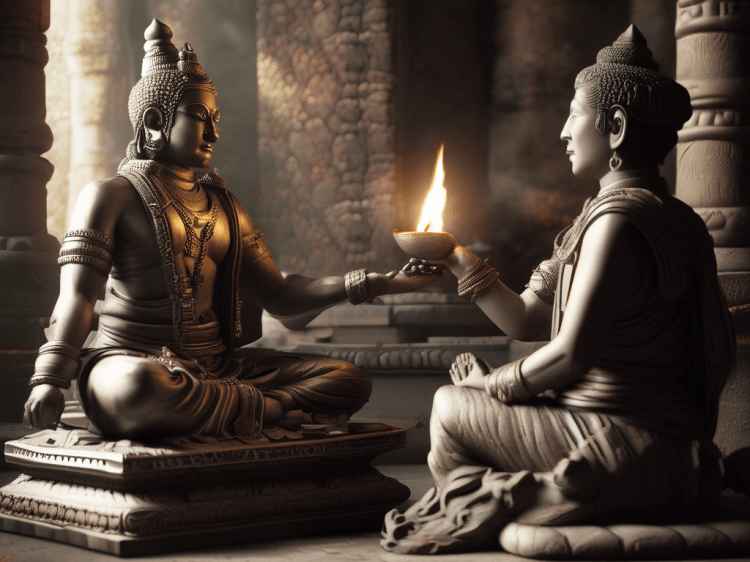
In the previous episode, we had witnessed Bhishmachaarya’s detailed accord to Yudishtra on how “belief” can both be futile as well as fruitful. For this, we’ve to understand what kind of beliefs we have within us. To highlight this point, Bhishmachaarya had resorted to narrating a very interesting story about a king approaching Sage Thanu to bring back his dead son to life. While initially Sage Thanu denied by saying that dead people cannot be brought alive in this world and this belief that the king is having is futile in nature, he also explains which are those beliefs that are extremely fragile and futile in nature. However, the king did not lose his belief on Sage Thanu, which moved him. With his power of penance, Sage Thanu brought back the king’s son to life, and now a new round of discussion happened about belief. From saying that belief is very futile in nature, Sage Thanu changes his narrative a bit and says that belief is good to have, if it is directed towards the right person / Bhagawan. For instance, we go to a temple with the belief that Bhagawan will resolve our personal problems and restore happiness. Of course, if our belief is 100% and if this converts into steadfast faith and surrender, Bhagawan definitely answers our prayers. However, if we go with a half-hearted approach towards Bhagawan without surrender, belief can become fragile. Here in this context, the king came to Sage Thanu with an unshakable belief that he would definitely get his dead son back. Hence, the sage could not deny the king’s belief and he made it come true! This is what we’ve to understand from this entire narrative of belief.
Moving on further thus, Yudishtra takes the dialogue forward with another very important question. He asks Bhishmachaarya thus, “Oh great Bhishmachaarya! You’ve spoken about belief, trust, etc. elaborately to me as important qualities of a leader. Now I have a doubt – If for instance, your ministers ditch you and join the enemy camp, if your army people ditch you and join the enemy camp, if you lose all your ways of earning wealth and sustaining the kingdom, as a king, how should I handle it? You’ve spoken about trust and belief, haven’t you? If trust and belief are breached by others around you, how should a king handle this?” As Yudishtra asks thus, Bhishmachaarya heaves a huge sigh and replies back thus, “Oh Yudishtra! You’ve asked a very important and a pertinent question here. This invokes me to going into a very important part of “Dharma” which is called “Aapad-Dharma”. Till now I’ve been explaining to you several aspects of “Raaja-Dharma”, but the answer for your question will not fit into this context. I’ve to explain a great deal of things to make you understand the answer for this question. Of course, it is not easy! If someone whom you trust the most deserts you and goes into the fold of an enemy camp, it can give you a rude shock and you might struggle to cope up with it. These are critical situations (“Aapad”) and they should be handled very carefully. Now let me take you through the nuances of “Aapad Dharma” little by little!”
Saying thus, Bhishmachaarya commences an important discussion on “Aapad-Dharma”. Till now we’ve been witnessing several aspects of “Raaja-Dharma” and with the discussion on trust and belief, we come to the end of this important segment. Now, as Yudishtra asks this important question, Bhishmachaarya uses this to commence an important discussion on the “Aapad-Dharma”. Here we’re going to see how a leader should handle catastrophic situations. It is very important for a leader first of all to keep very calm and composed at all times. We’ve been seeing this for quite some time now. But there are more aspects to just keeping calm and composed, which we’re going to witness in detail as part of the “Aapad-Dharma” discussion. Bhishmachaarya commences with an opening statement thus, “Oh Yudishtra! You should always remember one thing – A king should always have his coffers full at all times. During adverse situations, a king should not hesitate to collect taxes and fill up the coffers and when the situation turns favourable, the king should be generous enough to give it back to people in the form of developmental activities! However, at any point in time, the coffers of the kingdom should always have wealth. There should never be a situation wherein the coffers are empty, especially at a time when the situation demands it!”
This is a very important point that Bhishmachaarya is stressing upon here, which is also applicable to today’s context as well – Wealth in the form of money, reserves such as gold, dollars, etc. are to be stacked up to the fullest capacity at all times by the government at all times. Especially when there are catastrophic situations to handle, these reserves will come in handy. However, even during tough situations, the government should not stop or shy away from collecting taxes and filling up the coffers. This is because, we never know when there might be a huge expenditure for the government, and at that critical time, it would be difficult to scout and scamper for money elsewhere. This is the reason why several countries today are in a condition of mounting debts. Just because the governments aren’t able to fill up the coffers at the right time using the right strategies, they are forced to start printing excess currency notes, which is not a good sign for a country’s growth and development.
So for today, the message from Bhishmachaarya to administrators is this – Collect as much wealth as possible even during tough times and ensure that coffers are full at all times. This would ensure preparedness while handling and navigating through tough times. We shall develop this important point further in the upcoming episode as well! Stay tuned! 🙂
 The Indian Dharma