
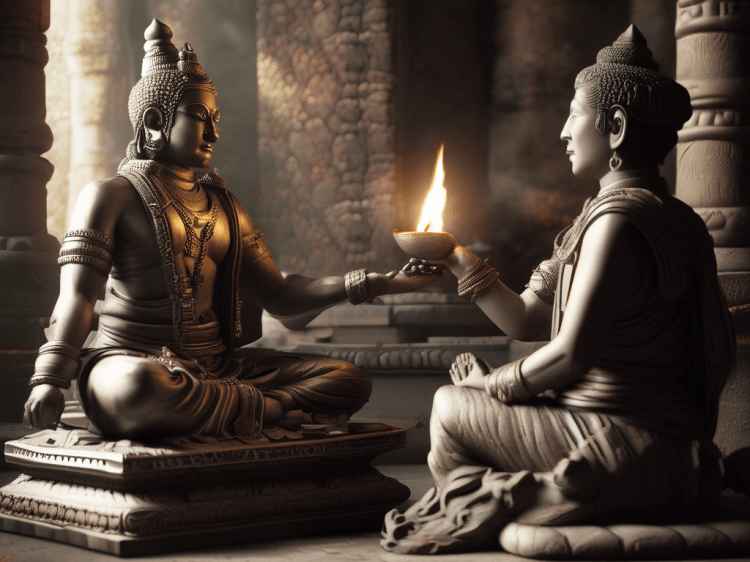
We’ve witnessed an important accord from Bhishmachaarya in the form of a beautiful story on how “Trust” is a key factor in leadership. This comes at a time when Yudishtra asks a very important question to Bhishmachaarya regarding whom to trust and whom not to. For this, Bhishmachaarya narrates the story of a “Dharmatma fox” and how it served as a minister in the tiger’s cabinet. We’ve seen that the tiger suspected the “Dharmatma fox” stealing its prey, and with this, the “Dharmatma fox” lost its trust towards the tiger. Once the trust was broken, it was broken forever. This could happen with all of us as well. In any form of relationship, whether it is personal or professional, when the trust factor goes for a toss, it is very difficult or nearly impossible to patch up again. This is just like a mirror – If the mirror breaks, it is next to impossible to fix the broken pieces of glass and bring it to the same original shape. Even if we try and fix the glass pieces, the cracks that were originally formed will still be visible, isn’t it? Here too, if the trust is broken once, it remains in people’s mind as a dark patch, which will never disappear.
Moving on further, there is one more point that needs to be highlighted from this tiger-fox story. Once a person bears an allegation / insult from the other, the respect and reputation that this person would carry, will also go for a toss amidst others, isn’t it? The “Dharmatma fox” himself says this to the tiger. He says thus, “Oh tiger! Now that you’ve alleged and insulted me in public amidst everyone that I’ve stolen your prey, all the others around you would be damn sure that I’m the one who had really stolen it. Now if you’re reinstating me as your minister, what will those people tell? Won’t it be a black mark for you also? The others would say that the tiger and the fox have entered into a “secretive deal” and it is because of this deal, the fox is back as the tiger’s minister. Isn’t this a bad reputation, both for you as well as for me? You might still try and justify to everyone that I’m innocent and you’ve made a mistake of casting a doubt over me for no fault of mine. However, once you’ve cast a doubt on me in public, that doubt will remain in their minds, and will refuse to accept your apology / justification later on! Hence, given this fact that I’m under an allegation, I refuse to continue as your minister henceforth!”
Now this point is extremely important here – The biggest mistake that the tiger has done here, as we see, is to come to an early conclusion and dismiss the “Dharmatma fox” without any investigation! Because the decision of the king is sacrosanct, people around the leader will go by whatever decision the king makes. After a point, if the decision has to be reversed, it talks very badly about the reputation of the leader. This rampantly happens in today’s administration too – If a minister is accused of corruption charges and is pending investigation, just like the “Dharmatma fox”, it is better to resign from the position, face the trial, prove himself / herself to the world that there’s no such mistake upon his / her name and take back the ministerial position thereafter. However, is it happening in today’s context? Many politicians in the greed for power, never step down if there’s a corruption allegation on them. They cling on to their position and deliberately try to sabotage the investigation, even as the courts watch on helplessly! This is the reason why I always keep lamenting over the fact that in India, the judiciary has been reduced to a mere joke in the hands of the corrupt lawmakers and bureaucrats. Anybody in the higher ranks can easily manipulate the law and get away without any punishment today, and sadly the courts in India, including the Supreme Court cannot do anything about this! The situation cannot go worse than judges getting bribes for delivering verdicts in favor of one party! If such is the case, how can we as common people expect a fair justice?
Thus, the point here is that, if there’s an allegation, it is better to step down, face a clean investigation, prove our point and then ascend the throne again, rather than being power-hungry and clinging to the chair, just to satisfy our own ego. The more and more we try to cling on without trying to prove ourselves, the more people will lose trust in us as leaders. So for today, let us spend time pondering over this thought with regards to trust and how to develop and nurture trust amongst our peers and colleagues. We shall wait till the next episode to move on with Bhishmachaarya’s next point of discussion! Stay tuned! 🙂
 The Indian Dharma