
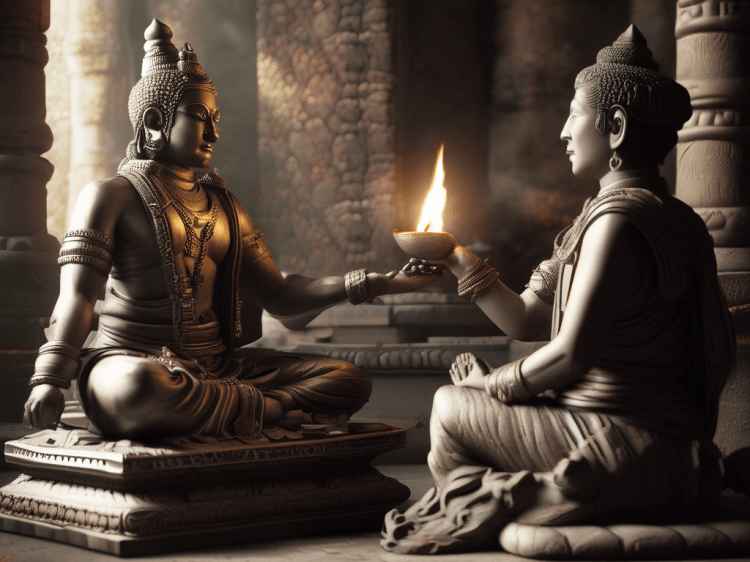
In the previous episode, we had witnessed Bhishmachaarya continuing with his accord on the “Aapad-Dharmam” to Yudishtra, which is part of a bigger discussion on the “Raaja-Dharma”. As part of this discussion, we’ve also witnessed thirty-six qualities of a leader, beyond which, he is now talking about the nuances behind “Mithram” (Friendship) for a leader. While alliances / friendships are essential and integral part of leadership, who are the ones to be considered as close aides or opportunists need a lot of introspection within all of us as well, in today’s context. Given that today’s world is extremely competitive, it is quite natural that people around us would be opportunistic in some way or the other. It is this element which Bhishmachaarya is also explaining in-depth in subsequent pointers that he’s giving here. In these lines, we’ve seen yesterday as to “who should be kept where” when it comes to allowing people to come into our closer circles. Those who are opportunistic and expect something in return from us all the time, should always be kept at a distance. Whereas, those who are kith and kin with us both during happiness and suffering, should be kept near us at all times. However, those people who are “Dharmatmas” should be kept as our extremely close-aides, because they would be the people who will guide us correctly in our path.
This is exactly what we see in a modern-day leadership concept called “Situational Leadership Theory”, wherein it is said that those people who are “Able” and “Unwilling” should be monitored the most. This theory categorises people into four different types. For those people who have infinite abilities but are unwilling to do anything, a leader should be on top of them everytime, to monitor their working periodically. This is because these people have “attitude issues”. Second category is those who are “Unable” and “Unwilling”. In this case, this person neither has the ability nor has a good attitude to learn to do things. In such cases, a leader has his task cut out! In fact, these are the toughest lot of people that a leader has to handle. Whereas, the third category of people – “Unable” and “Willing”, are quite easy to manage – This is because these people have a good attitude and are ready to learn. For such people, imparting necessary skills is easy, and hence, the amount of monitoring that the leader has to do becomes lesser. Finally, those people who are “Able” and “Willing” need not be monitored at all. They are self-motivated individuals and the leader’s role here becomes that of a facilitator.
If we compare this theory with whatever Bhishmachaarya has explained here, there are enormous resemblances. While this “Situational Leadership Theory” of Hersey and Blanchard (1969) explains that the last category (“Able” & “Willing”) should be given the maximum autonomy, Bhishmachaarya (5000+ years ago) says that those people who are “Dharmatmas” should be given the most autonomy! Those people who are “Bhajamana” and “Sahaja” will stand by us at all times and will be loyal and high-performing, and can be entrusted with any job with little monitoring and mentoring. This can be equated to the two categories of “Unable & Willing” and “Able & Willing” of Hersey and Blanchard (1969). Finally, those who are opportunistic, per Bhishmachaarya (“Sahaartha” & “Krithrima”) are the ones who fall under the “Able & Unwilling” and “Unable & Unwilling” categories of people. These are the ones who can never be trusted and can ditch you at any point!
From this discussion, it is very interesting as to how parallels can be drawn from ancient wisdom of leadership and the contemporary theories / ideas of leadership. Moving on further, Bhishmachaarya outlines the important role of a leader – “Monitoring”. This is extremely important. Bhishmachaarya explains to Yudishtra thus, “Oh Yudishtra! If you’re deputing some task to your people, you should not become complacent that they will do everything! You need to monitor the progress of work very carefully from time to time. Else, people will sleep on the task and ultimately the outcome will get affected! You need to be on top of people at all times, so that the task is finished successfully! As a king, you should have this skill of monitoring your people effectively!”
This is a very important point, which needs an elaborate discussion. So for today, let us understand up to this point and in the next episode, we shall continue this further! Stay tuned! 🙂
 The Indian Dharma