
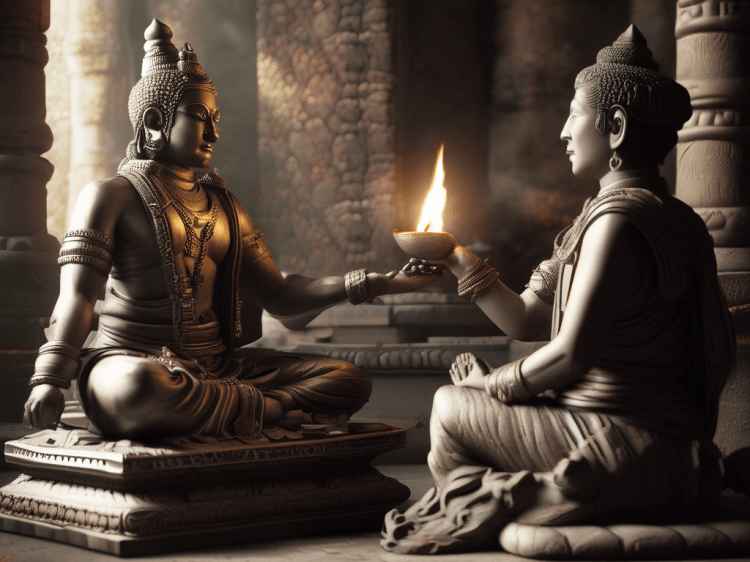
In the previous episode, we had witnessed Bhishmachaarya’s detailed accord on “Aapad-Dharmam” to Yudishtra, as part of the “Raaja Dharma” discussion. Here, the discussion commences with Yudishtra asking an important question as to who is a true friend and a true enemy. Bhishmachaarya picks it up from there and continues by saying that “time” and “situation” makes a good friend / enemy in life. A good friend today might become our most bitter enemy tomorrow and vice versa, depending upon the situation in which we are in. To follow it up, Yudishtra asks Bhishmachaarya as to how do we treat our friends. Given that a king cannot be successful without meaningful alliances, what is the extent to which alliances can help and what is the point of limitation for these alliances. For this, Bhishmachaarya is going to give an important reply, which we are going to witness today.
So Bhishmachaarya explains thus, “Oh Yudishtra! This is a very important question that you’ve asked me. Of course, you are right – Nothing can function in this world without alliances / relationships. In fact, Bhagawan Krishna Himself has mentioned in the Bhagawad Gita that “Karma Yoga” and “Gnyaana Yoga” are two alliances with which we’ve to approach the “Bhakti Yoga” to attain the ultimate “Moksha”. If such is the case, everything in this world is related to each other in some way or the other. The only person in this world who does not need a “Sahaayam” (Alliance) is Bhagawan Himself. When we offer “Sharanagati” towards Bhagawan, He doesn’t expect anything from anyone. He provides His divine “Anugraha” then and there to those who offer “Sharanagati” whole-heartedly. While Bhagawan doesn’t need any “Sahaayam” for Himself, all of us being normal people, require “Sahaayam” at different points in time. Now let me talk about four different types of “Mitra” (friendships) – “Sahaartha”, “Bhajamaana”, “Sahajan” and “Krithrima”. “Sahaartha” means, people who are friends with us, expecting something fruitful out of this friendship. In other words, it is like “You give me something, I will give you something back!” If the other person doesn’t find anything meaningful in us, he / she might not be friends with us. This is called “Sahaartha”. “Bhajamaana” means friendship occurring due to family bonding. For instance, our immediate cousins, brothers, sisters, and other relatives might fall under this category. All relatives (put together) are considered as “Bhajamaana”. “Sahaja” means people who are friends through kith and kin. Many of us might have “childhood friends”, don’t we? We might have been in the same school from Class 1 to 12, then in the same undergraduate school, post graduate school, etc. and even in the same job as well! In other words, there might be some people in our lives who are with us all through, even though they might not be part of our family in any way. Also, we might have a few friends who are very close to us, who do not expect anything in return from us. We term them as “family friends”, because, whatever we go through in our lives – Happy and sad moments, they are always with us. Finally, “Sahaartha” means those people who are highly opportunistic in nature. For instance, some people would come to us asking for money as a debt. We will also give them and after whatever task they might accomplish, they would repay that money back. After this transaction is over, they might not be in touch with us at all! Next time when they want money again, they will come to us. This kind of “Mithra” (Friendship) is called “Sahaartham”. In other words, people under this category only want “Sahaayam” from us at all times and nothing else!”
This is a very important point that Bhishmachaarya is highlighting, and for today, let us understand this. We shall wait till the next episode to continue further from here! Stay tuned! 🙂
 The Indian Dharma