
In the previous episode, we had witnessed the continuation of Bhishmachaarya’s accord on the “Raaja-Dharma” to Yudishtra. In particular, Bhishmachaarya is currently explaining thirty-six important qualities of a leader and we’ve witnessed around twenty-five of them till now. During the last episode we had witnessed Bhishmachaarya explaining how a leader should always be an epitome of humility, especially towards elders and the Guru. Especially when it comes to our teachers, we should be extremely humble towards them, no matter how much we might have achieved in our professional and personal lives. If our kindergarten teachers hadn’t laid the proper foundation for us during our early years, we would have never reached great heights in our lives today. Hence, we should always be grateful to them for all that they have imparted to us – especially the value systems and discipline aspects of learning.
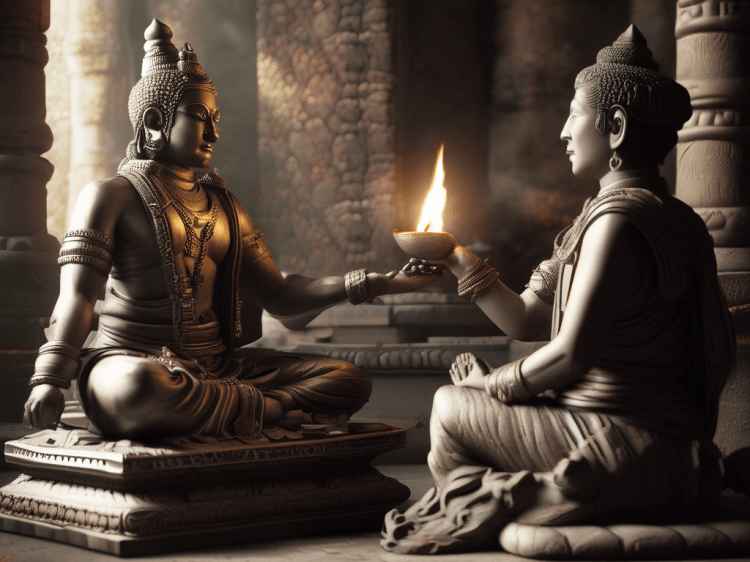
Next, moving on further, Bhishmachaarya explains thus, “Oh Yudishtra! Whenever you’re offering prayers to “Devatas” and Bhagawan, you should do it for the upliftment of your “Atman” and your kingdom, and not to obtain any kind of name and fame out of it!” This is also a very important point here. Whenever we perform offerings to Bhagawan, it is better not to invite a lot of media / social attention. This should be the formula even when we visit temples to worship Bhagawan. Nowadays, it has become a trend of taking “selifes” and posting them on social media accounts, whenever we visit places. It is saddening to see that many people are more interested in their own self-propaganda while visiting temples, rather than being interested in worshipping Bhagawan. When we visit a temple, our focus, involvement and conversation should only be towards the Deity in the temple and not anything else. Even casual conversations with people around should be avoided while being in a temple. The conversation should only be with Bhagawan. Silence is the best aspect to follow while being in a temple. While we say this, it automatically implies that usage of mobile phones and other electronic devices in a temple premises should be strictly prohibited. Usage of such devices not only disturbs our own concentration and purpose behind visiting the temple, but also disturbs others who want to be focused on Bhagawan. Even if we disturb ourselves, we do not have any rights to disturb others while being in a temple. These are some basic etiquettes that we’ve to follow while visiting a temple or any place of worship across all religions.
Moving on further, Bhishmachaarya explains thus, “Oh Yudishtra! If elders say something, you should not be adamant and stick to your stance. You should have the heart to relent from your hard stance and accept the words of elders!” We also have this problem today – We might narrow down on a decision, but if we have elders at home who might advise us an alternative decision for a problem, we might not be ready to consider it. Instead, we retaliate towards elders by saying that they are from an older generation and they do not understand the impact of the current day problem. Little do we understand that elders always talk out of experiences that they’ve had throughout their lives. Past experience is always like gold dust, and we should always pay heed to it. Perhaps, all their experiences might not be directly applicable to our current-day problems, but we can always filter them and take whatever is applicable, isn’t it? Moreover, rather than outrightly discarding the words of elders, we can always have the courtesy to listen to them patiently, right? This is a very good quality of a leader and we should try and introspect into this.
So for today, let us understand these two important qualities and we shall wait till the next episode to continue further. Stay tuned! 🙂
 The Indian Dharma