
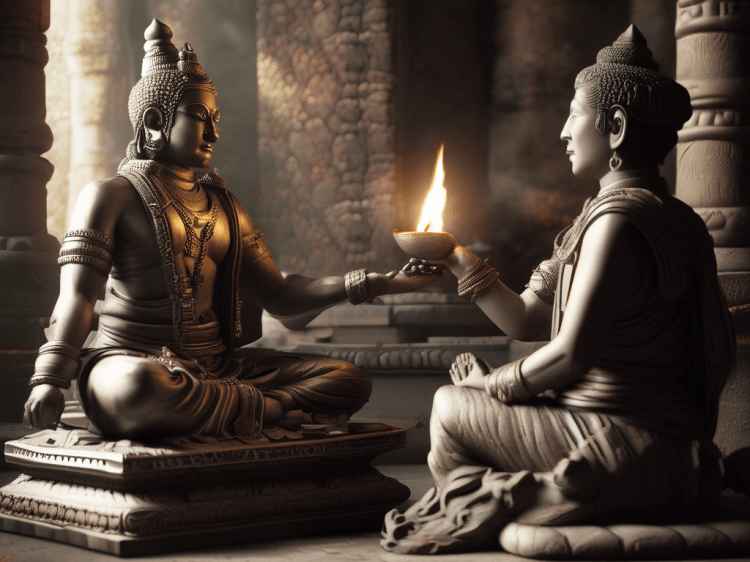
We’ve witnessed a beautiful and a structural build-up for Bhishmachaarya’s all-important accord on “Raaja-Dharma”. This is as part of the important “Shaanti Parva” of the Mahabharata text, wherein Bhishmachaarya is going to render important pieces of advice to Yudishtra pertaining to several aspects of “Dharma”. For now, we’re going to commence this discussion from the context of “Raaja Dharma”. In other words, what are the key roles and duties of an able administrator. These are going to be invaluable lessons, not only for Yudishtra, but also for all of us, and we are going to spend considerable time in this section of the Mahabharata, owing to the relevance that we have for today’s context. As we’ve witnessed yesterday, Yudishtra comes forward to talk with Bhishmachaarya, upon Bhagawan Krishna’s recommendation. Initially, Yudishtra feels shy and guilty upon seeing Bhishmachaarya’s pitiable state. He thinks that it is only because of his actions, Bhishmachaarya is in this sad state of affairs, only to be refuted by Bhishmachaarya himself! With this, Yudishtra gains some courage to come forward and thus, requests Bhishmachaarya to teach him more on the “Raaja Dharma”.
Now Bhishmachaarya begins with a very important note thus, “Oh Yudishtra! You’ve asked an important question, however, my tongue shivers with the thought that I’ve to give you an answer pertaining to “Dharma”. Here is Bhagawan Krishna, who Himself is an epitome of all “Dharma” in this world. However, He wants me to talk about “Dharma”! Of course, Bhagawan Krishna has provided me with His divine “Anugraha” to do so, and if it is His divine “Sankalpa” that words pertaining to “Dharma” should come out of my mouth, who can stop it from happening? Hence, with this courage, I’m commencing my accord! Oh Yudishtra! Please understand – For a king to be successful, two things are very important – The first one is “Prayathnam” (Effort) and the second one is “Puruhsaartham” (Goal). Every administrator, both in the professional and personal space should understand this very carefully. All of us should have a goal to achieve in life, and for doing so, we’ve to put in the requisite effort. For instance, if there is a CEO in an organization and if we’ve to ask him / her what their “Purushaartham” is. What will they answer? The CEO will say that his “Purushaartham” is to take the organization to great heights, in line with the “Vision” statement. In corporate terms, we can idealize “Purushaartham” as the “Vision” of an organization and “Prayathnam” as its “Mission” statement. We can see here that the Vision of any organization is the long-term goal that it wants to achieve for the benefit and transformation of the society in some way (depending upon the domain / industry in which the organization operates), and also for the organization’s own growth and development. “Prayathnam” here indicates the small baby steps that the organization takes every business day to achieve its long-term goal. There might of course be several short-term goals as we pass through the path, but ultimately the “Purushaartham” (Long-term goal) is important. Bhishmachaarya begins the entire discussion with this note, and this is why even today, when we teach “Strategy” in Management classes at top business schools, the discussion always commences with this concept only!
As we’ve understood the meanings of the terms “Purushaartham” and “Prayathnam” in the modern-day business context, now let us turn our lens towards our own spiritual growth and upliftment. If someone asks us thus, “What is your “Purushaartham” in life?” What will we answer them? We should say that our “Purushaartham” in this birth is to wash away all our “Karma-Phalam” (Both Sanchita Karma and Praarabhda Karma) and walk the path to attain “Moksha”. As ardent “Bhaktas” of Bhagawan Krishna, this should be our “Purushaartham”, isn’t it? Of course, we have Bhagawan Krishna’s guidance in several aspects of “Dharma” from His own Bhagawad Gita, and now we’re discussing Bhishmachaarya’s accord on “Dharma” in the divine presence of Bhagawan Krishna. What more guidance do we require? Hence, if we follow whatever these two people have told us, it implies that we are putting in the “Prayathnam” (Effort) to attain our “Purushaartham” (Long-term goal).
Now having said this, we’ve to understand the difference between having “Short-term goals” and “Long-term goals”. Why do we say that long-term goals are more important than short-term goals? Should we at all have short-term goals in life? Or, should we only have the long-term goal in our focus and leave the short-term goals completely? All these questions might keep haunting us in several walks of our professional and personal lives, don’t they? Bhishmachaarya is clearly explaining answers to these questions here – He says that while short-term goals are important for an administrator, the ultimate focus should be the long-term ones. When he talks about “Purushaartham”, he technically means the long-term goal, however, we’ve to balance the short-term goals, in order to attain the “Purushaartham”. For instance, in our personal lives, even though we have the long-term “Purushaartham” as attaining “Moksha” by washing away all our “Karma Phalam”, however, we’ve to get married, have a family, earn money, work with an organization, raise our children to the next level, take care of our own professional growth, etc. While all these are important too in life, we should treat them as “short-term goals”. Whereas, if we’re going to take the above-mentioned agenda as the long-term goal, we would be in for a soup! We would be deviating from our real “Purushaartham” as spiritual seekers. So the point here is that we’ve to prioritize what “Purushaartham” is for us and how we put in the “Prayathnam” to achieve it!
With this note, we shall ponder over these points for today, and we shall wait till the next episode to continue further! Stay tuned! 🙂
 The Indian Dharma